30 rokov ABIES - Ďakujeme všetkým našim priateľom, rodine, zákazníkom, partnerom za doterajšiu spoluprácu a spoločný rast.
Záhradníctvo ABIES®, Labutia 18, 931 01 Šamorín, časť Čilistov
 |
 |

30 rokov ABIES
e-mail: dreviny@dreviny.sk
+421 948 937 895 (Sale of Plants)
+421 948 877 888 (Garden Design and Landscaping)
+421 903 769 164 (Sale of Plants, Landscaping)


| search on: G | records:54 |
| 1. | Gold Dust Japanese Aucuba Description: Aucuba japonica Variegata is a great choice for even the shadiest of landscapes because it is extremely shade tolerant. It also grows well in partial sun. It grows to a form of a rounded, evergreen shrub. It has large, elliptic, glossy, yellow spotted, leathery leaves. Under dense trees, its roots compete successfully with other roots. It also tolerates pollution and performs well in containers. In spring it bears small purple-red flowers, female plants produce red berries. In cooler climates, this plant can take more sun, but really shines in deep shade where most plants are known to decline. Its foliage is nice in flower arrangements. It is only winter-hardy to zone 6. Water during growing/blooming season, but do not make soil too soggy. Aucuba can also be used to create dense evergreen hedge. The hedges are to be pruned with secateurs in August. Aucuba can be used for hedges 1-2.5m high. Individual plants have to be planted 45-60cm apart. Freely growing shrubs reach 2.5m x 1.8m. Prune them in late winter or spring if you wish to restrict their growth |
Aucuba japonica Variegata | details |
| 2. | Globosum Norway Maple Description: Very regular globular maple - slowly growing bushy Norway maple variety grafted on a high stem. It has pretty luscious green and relatively large lobed leaves and in a small amount produces the typical winged seeds. Resistant against pollution. Very often it becomes a place for nesting of singing birds - in almost each globular maple you will find a birds nest. Even on busy city streets blackbirds like to nestle in its crown. Can be placed as a specimen and it is specially suitable for smaler and/or formal gardens, for entrance areas and for creation of smaller tree rows. In autumn its leaves show a pretty display of colours. Grows up to a same height and width - approx. 6m. |
Acer platanoides Globosum | details |
| 3. | Globosum Norway Maple Description: Very regular globular maple - slowly growing bushy Norway maple variety grafted on a high stem. It has pretty luscious green and relatively large lobed leaves and in a small amount produces the typical winged seeds. Resistant against pollution. Very often it becomes a place for nesting of singing birds - in almost each globular maple you will find a birds nest. Even on busy city streets blackbirds like to nestle in its crown. Can be placed as a specimen and it is specially suitable for smaler and/or formal gardens, for entrance areas and for creation of smaller tree rows. In autumn its leaves show a pretty display of colours. Grows up to a same height and width - approx. 6m. |
Acer platanoides Globosum | details |
| 4. | Glacier English Ivy Description: This new, variegated English ivy variety belongs to the hardier ones. It has beautiful, creamy white streaks running through the evergreen, maple-shaped leaves. It still retains all of the desireable qualities of regular English ivy, though. Spreading along the ground and rooting wherever the stems come in contact with soil, it can eventually fill large beds with its frosty looking leaves. It's still vigorous, but not to the point of being invasive. And perhaps most significantly, it's an evergreen and will provide interest year-round in your garden. In can be grown in raised, shaded pots or containers where it can cascade down while illuminating dark garden spots. It can be also let to grow up the trunk of trees and its backdrop is great also with other darker-foliaged plants. Glacier´s wonderful soft variegation is also nice to add to annual and perennial landscapes. It can climb up walls and cover items we would like to hide. Grows well in sun, partial and complete shade and reaches a height of 3m in maturity. |
Hedera helix Glacier | details |
| 5. | Gold Columnar Beech, Golden Fastigiate Beech, Dawyck Gold European Beech, Common Beech Description: Narrow columnar beech variety with upright branches and thick golden foliage. It is thought to be a seedling cross between Fagus sylvatica Dawyck and Fagus sylvatica Zlatia and it was first discovered at the fantastic Dawyck Botanic Gardens in Scotland. The tree has smooth gray bark and layered branches that curve slightly upwards. It produces a dense mass of foliage that is soft golden-yellow in spring, it darkens to lime green in summer before finally turning a brilliant golden-bronze in autumn before falling. Inconspicuous flowers in spring usually do not result in fruit. Common beech makes a striking landscape accent. It also works well for hedging or screening. It looks especially attractive planted against a dark background. Common beech performs best in moist, well-drained, acidic to alkaline soil in full sun. Established tree tolerates some drought. Fully hardy to min. -34°C. Winner of the prestigious Award of Garden Merit in 2002. |
Fagus sylvatica (silvatica) Dawyck Gold | details |
| 6. | Golden Oak Description: The bright and clear golden-yellow foliage throughout spring and summer of this very slow growing form of English oak is unequalled. Quercus robur Concordia is a rare tree of rounded habit, eventually reaching 10 m. At the ages of 10 years it reaches a height of 5m. It was originally raised in Van Geert's nursery at Ghent in 1843. Its cultivation in dappled light, or sun for just part of the day, is usually best but in good retentive soil it will flourish in full sun also. It is always slow growing but not difficult even over alkaline soils. Very cold hardy. |
Quercus robur Concordia | details |
| 7. | Golden Firethorn Description: Evergreen, dense, fast growing shrub of regular round habit and small oval dark green leaves. Grown for its dense inflorescences of small white flowers and masses of brightly coloured ball-shaped small fruits which surround the young branches all along their length. In case of Soleil d´Or variety they are bright yellow. They appear as green in Summer, change to yellow in Autumn and remain on branches untill eaten by birds in Winter. Firethorn is therefore suitable for gardens where singing birds are welcomed and we want to help them in Winter. It is entirely frost hardy and has good resistence against urban polution. Excellent for planting impenetrable hedges retaining leaves also in Winter. It has sharp thorns on its branches therefore it is also pretty resistant against vandalism. It does not require any special soil and tolerates shade and wind exposed positions. Excellent for training on a wall of any aspect. Unpruned shrubs grow to around 4x4m. |
Pyracantha coccinea Soleil d´Or | details |
| 8. | Golden Delicious Reinders Apple Description: |
Malus Golden Delicious | details |
| 9. | Golden Hornet Japanese Flowering Crabapple, Golden Hornet Showy Crabapple Description: Small, deciduous, fruit-bearing tree suitable for small gardens. Grown for white flowers in spring and a profuse and long lasting display of spherical golden-yellow-coloured fruits (2-3cm across). Flowers are fragrant, 2-5cm across, borne singly or in umbels. Small fruits have waxy skin, creamy white flesh and last well into winter. They attract birds. The tree itself prefers sun but will tolerate partial shade. Thrives vest in fertile, moist but well-drained soil. It is fully hardy. As with all apples, this tree may be affected by disease, but if the tree is properly pruned and fed these should not really be a problem. Prune in late winter or early spring, removing crossing shoots/boughs. Mulch root area with manure and apply a fertiliser in spring. Golden Hornet apple tree is also a very good donor of pollen for our apple varieties. It grows up to a height of 5m and spread of 4m. |
Malus Golden Hornet | details |
| 10. | Globosum Norway Maple Description: Very regular globular maple - slowly growing bushy Norway maple variety grafted on a high stem. It has pretty luscious green and relatively large lobed leaves and in a small amount produces the typical winged seeds. Resistant against pollution. Very often it becomes a place for nesting of singing birds - in almost each globular maple you will find a birds nest. Even on busy city streets blackbirds like to nestle in its crown. Can be placed as a specimen and it is specially suitable for smaler and/or formal gardens, for entrance areas and for creation of smaller tree rows. In autumn its leaves show a pretty display of colours. Grows up to a same height and width - approx. 6m. |
Acer platanoides Globosum | details |
| 11. | Grandiflora Clematis Description: Fully hardy in the UK, will grow on Northerly wall. In nutritious soil it grows quickly and after two years can reach height and/or spread of 10 metres. In May or June bears flood of large, white flat open flowers about 8cm wide. Dark green divided leaves. Ideal position is in full sun or semi-shade, tolerates shade well. Light pruning can be done at the end of flowering period. |
Clematis montana Grandiflora | details |
| 12. | Gipsy Queen Clematis Vine Description: A healthy, floriferous cultivar of medium growth. Large, star-shaped, rich velvety violet-purple flowers with red anthers are borne in great profusion from July to September. Ideal for growing over fences, walls, arbors, pergolas, trellises and wooden supports. It can clamber over natural supports e.g. small trees and large, deciduous or coniferous shrubs. |
Clematis Gipsy Queen | details |
| 13. | Globehead European Ash Description: This Globehead European Ash has dense, round, symmetrical slow-growing crown with a regular (or smooth) outline grafted on approx. 2m high standard. The dark green leaves are multi-divided to 3 to 4 cm long lanceolate or ovate leafleats and usually drop off in autumn while still green but sometimes may turn an attractive yellow first. The rounded silhouette of naked branches on top of the trunk and the black, dormant leaf buds help to make Globehead Ash an attractive winter landscape element. Recommended for smaller gardens, entrance area to houses or premises, as a part of shrub borders in both formal and unformal gardens on to parking lots. Globehead Ash should be grown in full sun or partial shade and prefers moist, rich soil. It grows however also on clay, loam, sand and acidic and alkaline soils and tolerates also poorly-drained, low-quality soils. It has high drought and salt tolerance. Its grafted globular crown can reach a diameter of 3-4m. |
Fraxinus excelsior Nana (Globosa, Nana) | details |
| 14. | Goldsturm Black-eyed Susan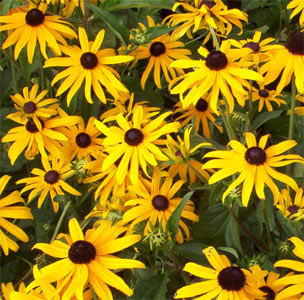 Description: |
Rudbeckia fulgida Goldsturm | details |
| 15. | Golden Showers Climbing Rose, yellow Description: An extremely popular yellow modern climbing rose that flowers from June right the way through to September. It has large, loosely formed flowers ragged edged flowers of deep golden-yellow fading to cream. The flowers have a licorice, tea fragrance. The blooms keep coming and the plant is prolific, as well as being disease-resistant. It may need a little encouragement to get going as a climber. It has dark, relatively thornless stems and glossy foliage. The plant has an upright habit, it is fully hardy and tolerant of poorer soils. It is very disease resistant and able to grow in sun, part shade but also shade and is therefore suitable for north wall. Can be pruned to maintain a shorter habit. It is most often used to decorate the wall, fence or to wrap around a pillar. The spent blooms should be removed to encourage good repeat-flowering. Bred in United States (1956) by Dr. Walter Lammerts. Parentage: Charlotte Armstrong × Captain Thomas. It received AARS awards in 1956, the Portland Gold Medal in 1957 and the Royal Horticultural Society Award of Garden Merit in 1993. Temperature zones 3 through 10. Grows to height of 2m and spread 3m in maturity. |
Rosa Golden Showers | details |
| 16. | Golden Ninebark Description: This shrub is beautiful with yellow-green leaves, with shape broadly oval, toothed and lobed. Clusters of white flowers, sometimes tinged pink, cover this dense, deciduous, spreading, arching, shrub from June to July. They look like a snowball. The height is 3m and width of this plant is 4m. Plant it on sunny, half shade or shadow place. |
Physocarpus opulifolius Luteus | details |
| 17. | Gold-leaved Mock Orange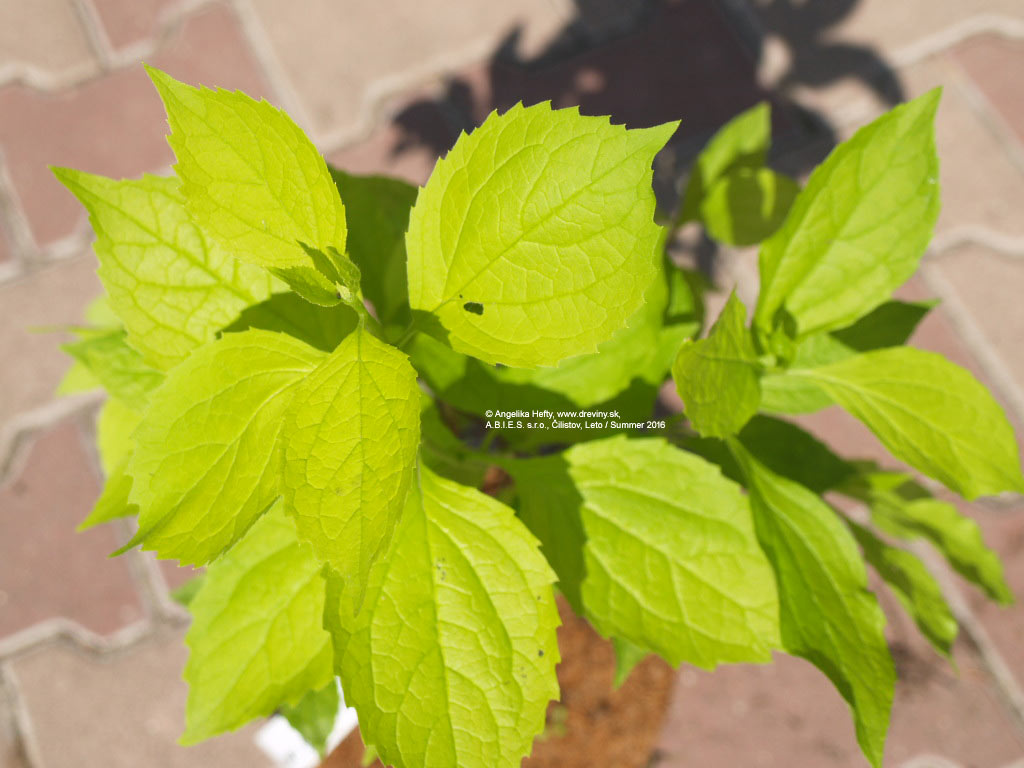 Description: A variety of the fragrant mock orange that has bright yellow new foliage. The colour gradually changes to greenish yellow as the season progresses. White scented flowers appear in June. The plant needs careful placing as too much sun can damage the foliage and if there is too much shade, it goes lime green. This shrub reaches height 2.50m and spreads 1.50m. |
Philadelphus coronarius Aureus | details |
| 18. | Grand fir, Lowland White Fir, Balsam Fir, Silver Fir, Yellow Fir Description: "Grand fir, also called lowland white fir, balsam fir, silver fir or yellow fir, is a rapid-growing and tall, stately tree that can grow up to 80 metres when mature. In Canada and USA it grows at 0-1500 m mostly in moist conifer forests. Grand fir has flat needles with rounded ends. They are dark green and grooved on top with two white bands underneath. Needles are arranged to form flat sprays. Grand fir seed cones are barrel-shaped and yellowish-green, growing upright on the branches, high in the crown. The cones shed the scales with the seeds during autumn. The bark of the tree is smooth and greyish-brown with white spots and blisters filled with gummy resin when young. The bark becomes furrowed and scaly with age. The soft white wood of grand fir is not very strong and more prone to decay then many other species but it is a valued source of pulpwood for paper making. It is also used for packing crates and construction work. The probably oldest grand fir tree is mentioned by P. E. Aho in his work from 1977. He cites a ring count of 472, of which 163 rings are in the first 7.6 cm of the sample (the tree was 87.6 cm DBH and 33.5 m tall). This indicates that the tree spent a long time in the forest understory as it is usual for grand firs growing on dry sites where they normally build-up a shade-tolerant understory. Grand fir is very shade tolerant, especially when young, although growth is slower in dense shade. It is able to grow on dry to moist soils. The name Abies is derived from the Latin abeo meaning ""to rise"" and refers to the great height attained by some species. Fir is derived from the Old English furh or fyrh or the Danish fyrr, meaning ""fire"", from its use as firewood. The luxuriant foliage, symmetry, deep green shiny colour and attractive scent make grand fir one of the preferred species of Christmas trees. The attractive appearance of grand fir makes it valuable in recreation areas and urban plantings. It is also planted as an ornamental tree in large parks." |
Abies grandis | details |
| 19. | Golden Weeping Willow, Niobe Weeping Willow Description: Among the hardiest and most beautiful weeping willows, the most frequently planted weeping tree, this one has bright golden yellow twigs on steeply pendulous branches which make a striking display in winter. The long skinny leaves turn yellow in fall. Whitish pussy willow flowers in spring can be quite showy. The tree itself is deciduous and wide spreading with slender pendulous yellow shoots falling to the ground as a curtain. In Spring the yellow green young leaves mature to mid green. Thrives best in full sun and moist soil. In maturity it reaches a height of 15m and spreads up to 20m. Poets and songwriters have immortalized Weeping Willows for the mood created by their long hanging branches and light feathery leaves. The softwood branches of Willow shrubs can be bent into furniture or baskets. Collect their pussy willows and colorful twigs for dried flower arrangements. Also valued for their fast growth, Willows are planted on the banks of streams and rivers to prevent erosion or to shade other slow-growing trees. They should be planted away from sewer lines and systems. They tolerate most soils, but need plenty of water. They thrive on ordinary loamy soil in damp or wet position and tolerate well chalky soils. Stake and train young Weeping Willows so that they grow tall enough for you to walk under their canopies. |
Salix chrysocoma Sepulcralis (Salix alba Tristis) | details |
| 20. | Giant Chinese Silver Grass Description: Miscanthus giganteus is a large perennial grass able to grow up to 3.5 or 4 metres in height. It forms large stands of strong stalks with large hanging leaves. Used as a specimen or in groups like screen, hedge, backdrop or vertical accent plant in wet areas of the landscape. It is also used for winter interest. Can be planted both in sunny or a shady positions. After warm summers in flowers in September. Flowers can be used in fresh or dried arrangements. Stems (when cut down in the spring) can be used for trellises or other garden support structures. Leaves are yellow to tan. Leaves are yellow to tan. It has a high rate of photosynthesis and shows rapid and vigorous growth. Studies were begun in the 1980s on its possible use as a source of raw material for industry and energy production. In addition to providing clean and affordable electricity and heat, Miscanthus is an environmentally friendly crop. Its large root system captures nutrients, and stems provide wildlife cover. Miscanthus sinensis prefers full sun and moist, rich soil that drains well. Slight drought can be tolerated once plants are established. New shoots begin to grow from the ground in March or April. Plants tolerate cold climates. Grow in full sun in average, moist, well-drained soil. Horticulturists claim it can be grown in zones 5-9, i.e. it can tolerate winter temperatures as low as -26 degrees Celsius (-15 degrees F). Begins to wither back in winter therefore we cut it back to 10cm in March, just before the new growth starts. |
Miscanthus sinensis Giganteus | details |
| 21. | Granny Smith Apple Description: One of the most widely spread apple variety Granny Smith has been discovered in Austrialia in the 1860s as a seedling. It is very good for cooking and eating. It has tough skin and excellent storage qualities. It requires a warm days and nights to ripen properly. The flavour of Granny Smith is acidic. It is a crisp hard and juicy apple with a pronounced taste. It can be very refreshing, and works well in salads because the slices do not brown as quickly as other varieties. This cultivar needs fewer winter chill hours and a longer growing season to mature the fruit, so it is favoured for the milder areas of the apple growing regions. |
Malus domestica Granny Smith | details |
| 22. | Globe Flowering Cherry, high standard Description: Globe flowering cherry is a wonderful variety of ornamental cherry with ball-shaped crown mostly grafted on standards from 80 up to 250cm. Thanks to its regular globular canopy form it is also ideal for small gardens and landscaping design (e.g. planting of alleys). It has small oval dark-green leaves and small white flowers appear on the tree in April or May. Similarly as the Umbrella Black Locust ( (Robinia pseudoacacia Umbraculifera), also this cherry survives on poor and sandy soils. However, we recommend to plant it primarily into well-drained soils at lower altitudes where it thrives best. This Globe Folowering Cherry does not produce fruit. From time to time some fruit may appear but it is rather an exception. The globular canopy of this cherry grows up to a diameter of 2.5m, therefore it does not take up much space and throws its shadow only where needed. |
Prunus fruticosa Globosa (Globosum, eminens Umbraculifera) | details |
| 23. | Goshiki Chinese Holly, Goshiki Holly Tea Olive, Goshiki Holly Osmanthus, Goshiki False holly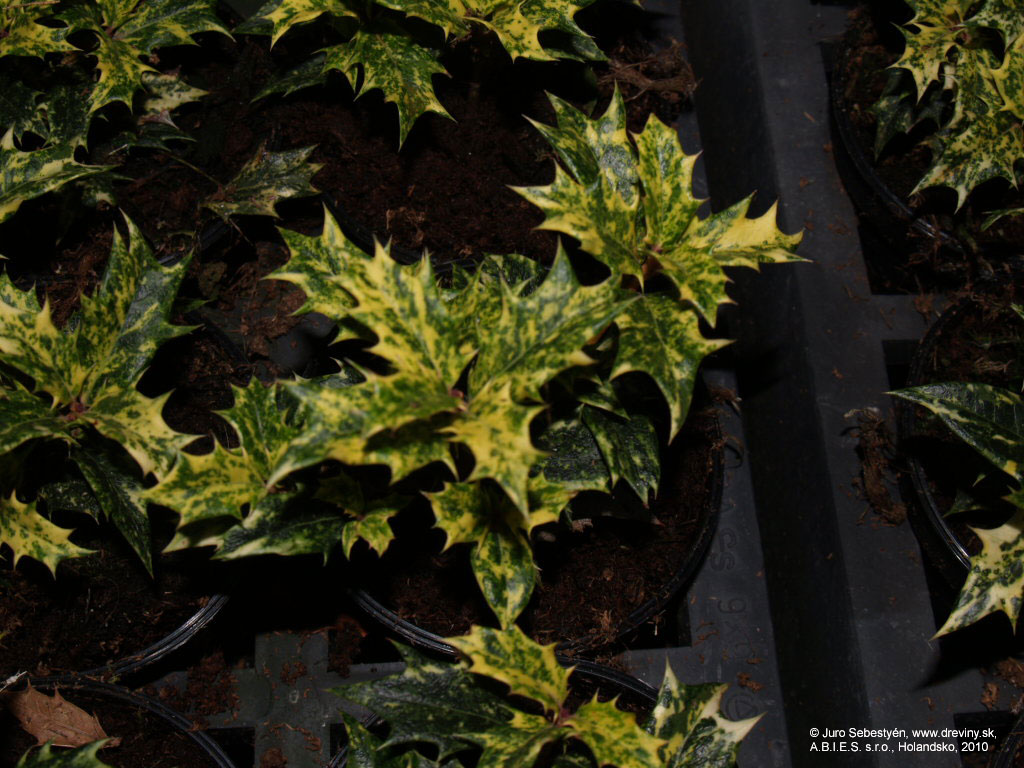 Description: |
Osmanthus heterophyllus Goshikii | details |
| 24. | Green Twister Coneflower Description: |
Echinacea purpurea Green Twister | details |
| 25. | Great Wall Blue Fountain Bamboo Description: Fargesia nitida Great Wall or otherwise known as Blue Fountain Bamboo is an outstanding ornamental evergereen bamboo with outward arching slender branches and dark purplish canes that are covered with a bluish-white powder. It is native to high mountain habitat in Central China where it grows at elevations over 2500m and is extremely hardy to -28°C. On the northern slopes of Himalaya mountains it can be even found at altitudes up to 3000 metres. As all bamboos however it prefers a position sheltered from cold winds. Fargesia nitida is a dainty, graceful, thin clumping bamboo with a very vertical visual pattern, upright and slightly arching at the tips. Its long, blue, arching culms with tiny leaves make this bamboo a beauty. The rich green leaves are delicate, and very attractive. The foliage seems to float around the whip-like culms. New thin shoots have a very vertical growth while mature culms are gently arching over at the top from the mass of foliage. Great Wall is a new generation clone not expected to flower for many years. It makes an excellent thick hedge or screen as well as good solitary specimen growing in large container. In its native country the canes are often used as plant supports, they can also be woven into hurdles etc. and used for making baskets, sieves, light construction and fencing. Fargesia nitida prefers rich well drained soil and partial to full shade to perform its best. It grows also on sunny but requires moist soil. Grows to a height of 2 to 4m in maturity (according to climate conditions). |
Fargesia nitida Great Wall | details |
| 26. | Golden Olympic Rose (yellow climbing - in 3L pot) Description: This climbing rose flowers repeatedly from May until arrival of frost. It produces intensely yellow flowers. When climbing on support it can reach a height up to 350-400cm. It is resistant against diseases nad frost. |
Rosa Golden Olympic | details |
| 27. | Golden Margin English Holly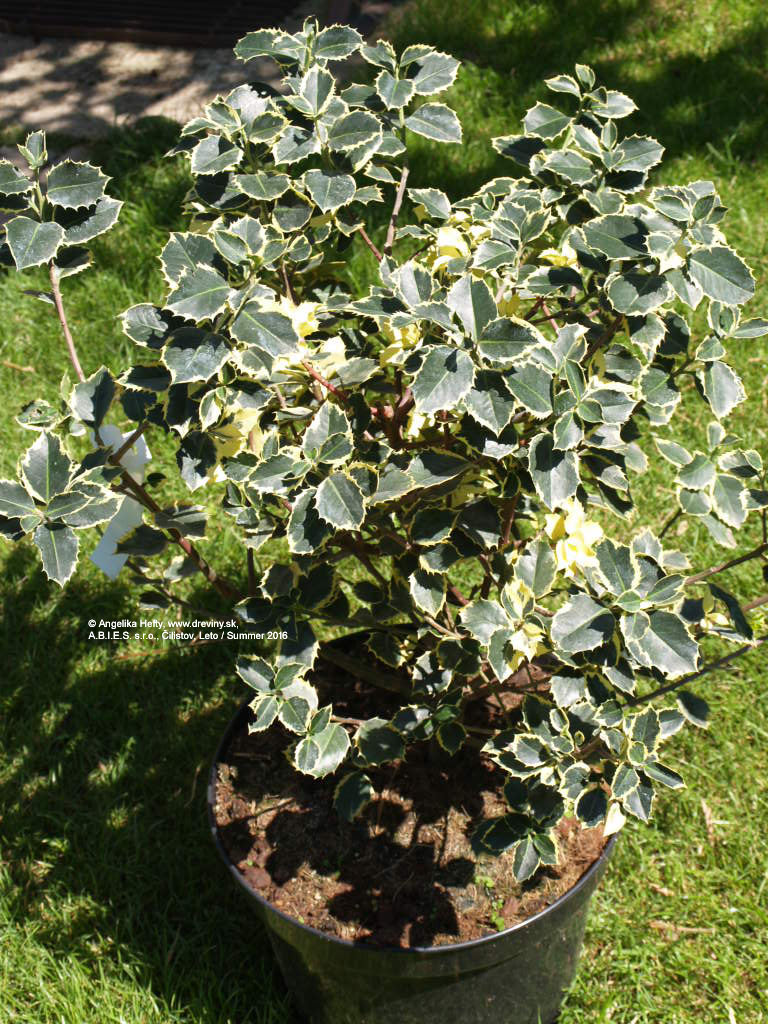 Description: This unique variety of English holly is a bushy and vigorous evergreen female holly hedge. It grows slowly, 25-30cm per year, and without pruning it can reach an ultimate height of 14m. Its leaves are glossy, dark-green with spiny, bright-gold margins. From May to June it bears small white and fragrant flowers that are followed by masses of bright-red berries. English holly makes an attractive backdrop for decorative plants within the garden or a specimen shrub. It may be also planted in groups and trained into a dense tree or a prickly, impenetrable hedge. It is tolerant of the most severe pruning, therefore can be grown in large containers for patio or terrace use. The decorative berries along with the colorful leaves are excellent for creating bouquets and flower arrangements. It thrives in moist, but well-drained, moderately fertile soil in sunny position. Hardy |
Ilex aquifolium Aureomarginata | details |
| 28. | Gooseberry Invicta Description: |
Grossularia albus Invicta | details |
| 29. | Golden Silk Bush Rose Description: |
Rosa Golden Silk | details |
| 30. | Globosum Norway MapleDescription: Very regular globular maple - slowly growing bushy Norway maple variety grafted on a high stem. It has pretty luscious green and relatively large lobed leaves and in a small amount produces the typical winged seeds. Resistant against pollution. Very often it becomes a place for nesting of singing birds - in almost each globular maple you will find a birds nest. Even on busy city streets blackbirds like to nestle in its crown. Can be placed as a specimen and it is specially suitable for smaler and/or formal gardens, for entrance areas and for creation of smaller tree rows. In autumn its leaves show a pretty display of colours. Grows up to a same height and width - approx. 6m. |
Acer platanoides Globosum | details |
| 31. | Golden Delicious AppleDescription: |
Malus domestica Golden Delicious | details |
| 32. | Globe Flowering CherryDescription: Globe flowering cherry is a wonderful variety of ornamental cherry with ball-shaped crown mostly grafted on standards from 80 up to 250cm. Thanks to its regular globular canopy form it is also ideal for small gardens and landscaping design (e.g. planting of alleys). It has small oval dark-green leaves and small white flowers appear on the tree in April or May. Similarly as the Umbrella Black Locust ( (Robinia pseudoacacia Umbraculifera), also this cherry survives on poor and sandy soils. However, we recommend to plant it primarily into well-drained soils at lower altitudes where it thrives best. This Globe Folowering Cherry does not produce fruit. From time to time some fruit may appear but it is rather an exception. The globular canopy of this cherry grows up to a diameter of 2.5m, therefore it does not take up much space and throws its shadow only where needed. |
Prunus eminens Umbraculifera | details |
| 33. | Globosum Norway MapleDescription: Very regular globular maple - slowly growing bushy Norway maple variety grafted on a high stem. It has pretty luscious green and relatively large lobed leaves and in a small amount produces the typical winged seeds. Resistant against pollution. Very often it becomes a place for nesting of singing birds - in almost each globular maple you will find a birds nest. Even on busy city streets blackbirds like to nestle in its crown. Can be placed as a specimen and it is specially suitable for smaler and/or formal gardens, for entrance areas and for creation of smaller tree rows. In autumn its leaves show a pretty display of colours. Grows up to a same height and width - approx. 6m. |
Acer platanoides Globosum | details |
| 34. | Galaxy Magnolia Description: Galaxy is a small deciduous tree of narrowly conical outline with oval, dark green leaves and deep red-purple buds opening to flowers 20 cm in width, with 12 petals light red-purple outside, paler rose within. Profusion of large, reddish-purple flowers bloom late in season. This deciduous hybrid offers candy-scented, goblet-shaped blooms to 10 inches across in vivid reddish-purple. It forms a pyramidal outline, and grows up to 40 feet tall. A strong, upright garden tree easily trained as standard. Handsome bright green foliage. Flower Red and Pale Purple in Spring Foliage Dark Green in Autumn, Spring and Summer Size Ultimate height 8-12 metres Ultimate spread 4-8 metres Time to ultimate height 10-20 years Deciduous. Moderate grower to 30 to 35 ft. tall, 15 to 20 ft. wide. Needs regular watering - weekly, or more often in extreme heat. Cold hardiness zones: 5 - 9. Grow in moist but well-drained neutral to acid soil in full sun or part shade with shelter from cold winds. Late frosts may damage flower buds. Pruning time: winter. |
Magnolia soulangena Galaxy | details |
| 35. | Greenspire Small-leaved Lime, Greenspire Small-leaved Linden, Greenspire Little-leaf Linden Description: Mittelgroßer Baum mit regelmäßiger, breit ovaler, dicht geschlossener Krone, Äste schräg aufsteigend, Zweige im unteren Bereich hängend, rasch wachsend. 15 bis 20 m hoch und 10 bis 12 m breit. Jahreszuwachs in der Höhe 40 cm, in der Breite 20 cm. Blätter sommergrün, wechselständig, schief herzförmig bis rundlich, 6 bis 10 cm lang und genauso breit, das ganze Jahr über dunkelgrün glänzend, ledrig, leicht muldenförmig, Herbstfärbung gelb. Blüten gelblichweiß, in 5- bis 11blütigen Trugdolden, Blüte mit dem Hochblatt verwachsen, süßlich duftend, ab Anfang Juli. Braun-filzig behaarte, ovale bis kugelige, dünnschalige Nüßchen mit nur schwach ausgeprägten Rippen. In den ersten sieben bis acht Jahren wird eine Pfahlwurzel gebildet, später kräftiges, unregelmäßiges Herzwurzelsystem, Feinwurzelanteil sehr hoch Standort - sonnig bis halbschattig. Sie wurzelt intensiver als Eiche, Hainbuche, Rotbuche, Birke, Esche, Schwarzerle und Ulme und ähnelt am ehesten dem Berg-Ahorn. Standort Bodeneigenschaften - auf mäßig trockenen bis frischen, nährstoffreichen, schwach sauren bis alkalischen Böden. Die Winter-Linde ist aber anpassungsfähig und gedeiht auch noch auf ärmeren Standorten, wenn diese nicht ausgesprochen trocken sind. Tilia mordacita ist anspruchsloser als T. platyphyllos, sie benötigt weniger Nährstoffe und Bodenfestigkeit. Frosthart, verträgt sehr gut Wärme und trockene Luft, gut hitzetolerant, stadtklimafest, nicht anfällig für Rotpusteln (BLAUERMEL), insgesamt wohl etwas anspruchsloser als T. cordata. |
Tilia cordata Greenspire (Tillia cordata Greenspire) | details |
| 36. | Globehead European AshDescription: This Globehead European Ash has dense, round, symmetrical slow-growing crown with a regular (or smooth) outline grafted on 180 cm high standard. The dark green leaves are multi-divided to 3 to 4 cm long lanceolate or ovate leafleats and usually drop off in autumn while still green but sometimes may turn an attractive yellow first. The rounded silhouette of naked branches on top of the trunk and the black, dormant leaf buds help to make Globehead Ash an attractive winter landscape element. Recommended for smaller gardens, entrance area to houses or premises, as a part of shrub borders in both formal and unformal gardens on to parking lots. Globehead Ash should be grown in full sun or partial shade and prefers moist, rich soil. It grows however also on clay, loam, sand and acidic and alkaline soils and tolerates also poorly-drained, low-quality soils. It has high drought and salt tolerance. Its grafted globular crown can reach a diameter of 3-4m. |
Fraxinus excelsior Globosum (Globosa, Nana) | details |
| 37. | Granny Smith Apple Description: One of the most widely spread apple variety Granny Smith has been discovered in Austrialia in the 1860s as a seedling. It is very good for cooking and eating. It has tough skin and excellent storage qualities. It requires a warm days and nights to ripen properly. The flavour of Granny Smith is acidic. It is a crisp hard and juicy apple with a pronounced taste. It can be very refreshing, and works well in salads because the slices do not brown as quickly as other varieties. This cultivar needs fewer winter chill hours and a longer growing season to mature the fruit, so it is favoured for the milder areas of the apple growing regions. |
Malus domestica Granny Smith | details |
| 38. | Gala Apple Description: |
Malus domestica Gala Must | details |
| 39. | Greenspire Small-leaved Lime, Greenspire Small-leaved Linden or Greenspire Little-leaf LindenDescription: Mittelgroßer Baum mit regelmäßiger, breit ovaler, dicht geschlossener Krone, Äste schräg aufsteigend, Zweige im unteren Bereich hängend, rasch wachsend. 15 bis 20 m hoch und 10 bis 12 m breit. Jahreszuwachs in der Höhe 40 cm, in der Breite 20 cm. Blätter sommergrün, wechselständig, schief herzförmig bis rundlich, 6 bis 10 cm lang und genauso breit, das ganze Jahr über dunkelgrün glänzend, ledrig, leicht muldenförmig, Herbstfärbung gelb. Blüten gelblichweiß, in 5- bis 11blütigen Trugdolden, Blüte mit dem Hochblatt verwachsen, süßlich duftend, ab Anfang Juli. Braun-filzig behaarte, ovale bis kugelige, dünnschalige Nüßchen mit nur schwach ausgeprägten Rippen. In den ersten sieben bis acht Jahren wird eine Pfahlwurzel gebildet, später kräftiges, unregelmäßiges Herzwurzelsystem, Feinwurzelanteil sehr hoch Standort - sonnig bis halbschattig. Sie wurzelt intensiver als Eiche, Hainbuche, Rotbuche, Birke, Esche, Schwarzerle und Ulme und ähnelt am ehesten dem Berg-Ahorn. Standort Bodeneigenschaften - auf mäßig trockenen bis frischen, nährstoffreichen, schwach sauren bis alkalischen Böden. Die Winter-Linde ist aber anpassungsfähig und gedeiht auch noch auf ärmeren Standorten, wenn diese nicht ausgesprochen trocken sind. Tilia mordacita ist anspruchsloser als T. platyphyllos, sie benötigt weniger Nährstoffe und Bodenfestigkeit. Frosthart, verträgt sehr gut Wärme und trockene Luft, gut hitzetolerant, stadtklimafest, nicht anfällig für Rotpusteln (BLAUERMEL), insgesamt wohl etwas anspruchsloser als T. cordata. |
Tilia cordata Greenspire (Tillia cordata Greenspire) | details |
| 40. | Grand Amore Rose, Korcoluma Rose, My Valentine Rose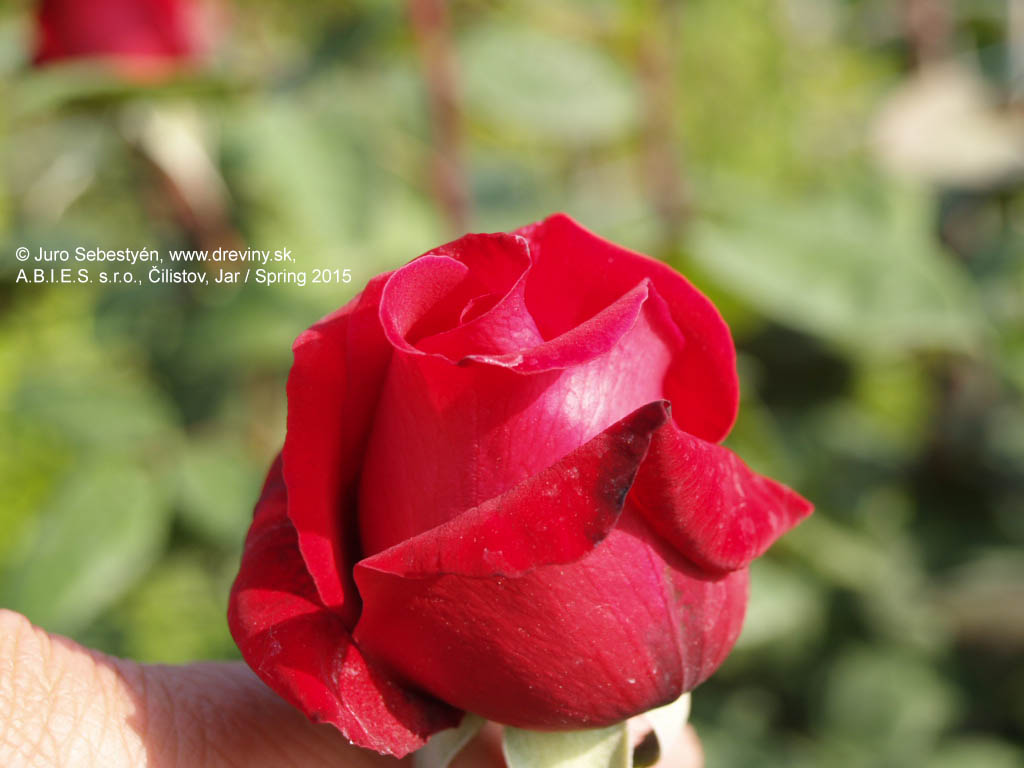 Description: |
Rosa Grande Amore (Korcoluma, My Valentine) | details |
| 41. | Grape Chrupka biela Description: |
Vitis vinifera Chrupka biela | details |
| 42. | Grape Merkúr Description: |
Vitis vinifera Merkúr | details |
| 43. | Grape Elma Description: |
Vitis vinifera Elma | details |
| 44. | Globe Flowering Cherry, high standardDescription: Globe flowering cherry is a wonderful variety of ornamental cherry with ball-shaped crown mostly grafted on standards from 80 up to 250cm. Thanks to its regular globular canopy form it is also ideal for small gardens and landscaping design (e.g. planting of alleys). It has small oval dark-green leaves and small white flowers appear on the tree in April or May. Similarly as the Umbrella Black Locust ( (Robinia pseudoacacia Umbraculifera), also this cherry survives on poor and sandy soils. However, we recommend to plant it primarily into well-drained soils at lower altitudes where it thrives best. This Globe Folowering Cherry does not produce fruit. From time to time some fruit may appear but it is rather an exception. The globular canopy of this cherry grows up to a diameter of 2.5m, therefore it does not take up much space and throws its shadow only where needed. |
Prunus fruticosa Globosa (Globosum, eminens Umbraculifera) | details |
| 45. | Greenspire Small-leaved Lime, Greenspire Small-leaved Linden, Greenspire Little-leaf LindenDescription: |
Tilia cordata Greenspire (Tillia cordata Greenspire) | details |
| 46. | Giant Chinese Silver GrassDescription: Miscanthus giganteus is a large perennial grass able to grow up to 3.5 or 4 metres in height. It forms large stands of strong stalks with large hanging leaves. Used as a specimen or in groups like screen, hedge, backdrop or vertical accent plant in wet areas of the landscape. It is also used for winter interest. Can be planted both in sunny or a shady positions. After warm summers in flowers in September. Flowers can be used in fresh or dried arrangements. Stems (when cut down in the spring) can be used for trellises or other garden support structures. Leaves are yellow to tan. Leaves are yellow to tan. It has a high rate of photosynthesis and shows rapid and vigorous growth. Studies were begun in the 1980s on its possible use as a source of raw material for industry and energy production. In addition to providing clean and affordable electricity and heat, Miscanthus is an environmentally friendly crop. Its large root system captures nutrients, and stems provide wildlife cover. Miscanthus sinensis prefers full sun and moist, rich soil that drains well. Slight drought can be tolerated once plants are established. New shoots begin to grow from the ground in March or April. Plants tolerate cold climates. Grow in full sun in average, moist, well-drained soil. Horticulturists claim it can be grown in zones 5-9, i.e. it can tolerate winter temperatures as low as -26 degrees Celsius (-15 degrees F). Begins to wither back in winter therefore we cut it back to 10cm in March, just before the new growth starts. |
Miscanthus sinensis Giganteus | details |
| 47. | Grape No-13 Description: |
Vitis vinifera No-13 | details |
| 48. | Great Wall Blue Fountain Bamboo Description: Fargesia nitida Great Wall or otherwise known as Blue Fountain Bamboo is an outstanding ornamental evergereen bamboo with outward arching slender branches and dark purplish canes that are covered with a bluish-white powder. It is native to high mountain habitat in Central China where it grows at elevations over 2500 metres and is extremely hardy to -28°C. On the northern slopes of Himalaya mountains it can be even found at altitudes up to 3000 metres. As all bamboos however it prefers a position sheltered from cold winds. Fargesia nitida is a dainty, graceful, thin clumping bamboo with a very vertical visual pattern, upright and slightly arching at the tips. Its long, blue, arching culms with tiny leaves make this bamboo a beauty. The rich green leaves are delicate, and very attractive. The foliage seems to float around the whip-like culms. New thin shoots have a very vertical growth while mature culms are gently arching over at the top from the mass of foliage. Great Wall is a new generation clone not expected to flower for many years. It makes an excellent thick hedge or screen as well as good solitary specimen growing in large container. In its native country the canes are often used as plant supports, they can also be woven into hurdles etc. and used for making baskets, sieves, light construction and fencing. Fargesia nitida prefers rich well drained soil and partial to full shade to perform its best. It grows also on sunny but requires moist soil. Grows to a height of 2 to 4m in maturity (according to climate conditions). |
Fargesia nitida Great Wall | details |
| 49. | Golden Weeping Willow, Niobe Weeping WillowDescription: Among the hardiest and most beautiful weeping willows, the most frequently planted weeping tree, this one has bright golden yellow twigs on steeply pendulous branches which make a striking display in winter. The long skinny leaves turn yellow in fall. Whitish pussy willow flowers in spring can be quite showy. The tree itself is deciduous and wide spreading with slender pendulous yellow shoots falling to the ground as a curtain. In Spring the yellow green young leaves mature to mid green. Thrives best in full sun and moist soil. In maturity it reaches a height of 15m and spreads up to 20m. Poets and songwriters have immortalized Weeping Willows for the mood created by their long hanging branches and light feathery leaves. The softwood branches of Willow shrubs can be bent into furniture or baskets. Collect their pussy willows and colorful twigs for dried flower arrangements. Also valued for their fast growth, Willows are planted on the banks of streams and rivers to prevent erosion or to shade other slow-growing trees. They should be planted away from sewer lines and systems. They tolerate most soils, but need plenty of water. They thrive on ordinary loamy soil in damp or wet position and tolerate well chalky soils. Stake and train young Weeping Willows so that they grow tall enough for you to walk under their canopies. |
Salix chrysocoma Sepulcralis (Salix alba Tristis) | details |
| 50. | Golden Delicious AppleDescription: |
Malus Golden Delicius | details |
| 51. | Golden Weeping Willow, Niobe Weeping WillowDescription: Among the hardiest and most beautiful weeping willows, the most frequently planted weeping tree, this one has bright golden yellow twigs on steeply pendulous branches which make a striking display in winter. The long skinny leaves turn yellow in fall. Whitish pussy willow flowers in spring can be quite showy. The tree itself is deciduous and wide spreading with slender pendulous yellow shoots falling to the ground as a curtain. In Spring the yellow green young leaves mature to mid green. Thrives best in full sun and moist soil. In maturity it reaches a height of 15m and spreads up to 20m. Poets and songwriters have immortalized Weeping Willows for the mood created by their long hanging branches and light feathery leaves. The softwood branches of Willow shrubs can be bent into furniture or baskets. Collect their pussy willows and colorful twigs for dried flower arrangements. Also valued for their fast growth, Willows are planted on the banks of streams and rivers to prevent erosion or to shade other slow-growing trees. They should be planted away from sewer lines and systems. They tolerate most soils, but need plenty of water. They thrive on ordinary loamy soil in damp or wet position and tolerate well chalky soils. Stake and train young Weeping Willows so that they grow tall enough for you to walk under their |
Salix chrysocoma Sepulcralis (Salix alba Tristis) | details |
| 52. | Globosum Norway MapleDescription: Very regular globular maple - slowly growing bushy Norway maple variety grafted on a high stem. It has pretty luscious green and relatively large lobed leaves and in a small amount produces the typical winged seeds. Resistant against pollution. Very often it becomes a place for nesting of singing birds - in almost each globular maple you will find a birds nest. Even on busy city streets blackbirds like to nestle in its crown. Can be placed as a specimen and it is specially suitable for smaler and/or formal gardens, for entrance areas and for creation of smaller tree rows. In autumn its leaves show a pretty display of colours. Grows up to a same height and width - approx. 6m. |
Acer platanoides Globosum | details |
| 53. | Goldrich Apricot Description: |
Prunus armeniaca Goldrich | details |
| 54. | Giant Sequoia, Sierra Redwood, Wellingtonia Description: Giant sequoias can grow up to 90 metres high and can weigh up to 5000 tons in their natural environment. They grow quickly when young and create a beautiful regular conical tree. The giant sequoias have a thick, fibrous, red-brown bark and rich blue-green leaves. This bark can be 30-60cm thick and protects the mature tree against forest fires. Fully grown sequoias belong to largest and oldest trees on Earth. In their native California they can live up to 1500-3000 years. One of the oldest sequoias has even reached the age of 5000 years. The trunk of a mature sequoia in its lower part grows to a diameter of 12 metres and its roots spread over an area larger then a football field. The largest diameter of the sequoia trunk known is 15 metres - corresponding to a circumference of 46 metres. It is known that there was a two lane road built through one sequoia in the Yosemite National Park, USA without seriously threatening the tree. At the time of America´s colonisation a team of four woodcutters needed up to 22 day to cut down one of these trees. The tree then provided sufficient wood to build up a small town. In Middle Europe the giant sequoias grows up to 30m high. They thrive best in deep, well-drained sandy loams. The longer-term soil flooding with associated lack of soil oxygen leads to gradual dying off of roots in most conifers and eventual death of the plants. Our own experience backed by literature says the the type of soil does not play very significant role in comparison with the soil humidity and its drainage. Sequoias in their homeland grow on soils with pH ranging mostly from 5.5 to 7.5, with an average of about 6.5. (Mallory, James 1. 1981. California State Cooperative Soil-Vegetation Survey, Redding, CA). THESE PLANTS ARE WELL ROOTED IN POTS THEREFORE YOU CAN PLANT THEM THROUGHOUT THE YEAR. |
Sequoiadendron giganteum Greenpeace | details |
Last update on:
07.11.2026 17:10:02
10% discount | Hedging plants | Climbing shrubs and plants | Trees, shrubs and bushes for half-shade | Plants for shade | Bonsai plants | Flowering plants | Plants for terraces and balconies | Evergreen plants | Miniature plants growing up to 1.5m | Conifers growing up to 1.5 - 3m | Conifers growing higher than 3m | Deciduous bushes | Deciduous plants growing up to 3m | Deciduous plants growing higher then 3m | Fruit trees and bushes | Perennials | Ground covering bushes and perennials | Trees and shrubs with ornamental fruit | With beautiful autumn leaf colour | Discounts | Having interesting winter colour or shape | Plants for acid soils | Plants for alkaline soils | Grasses | Bamboos | For rock gardens | Woody plants to lakes and streams | Water plants | Healing and aromatic plants | Citruses | Supplementary goods | Bulbs | Small trees up to 5m wide, for small gardens | Fertilizers | Christmas trees | Fruit trees | Herbs | Multi-stemmed trees |
Naši partneri:
Odborné preklady a tlmočenie, aj úradné, Bratislava
www.kochlik.sk - kvetináče
www.zavlahy-soos.sk - zavlažovacie systémy
soulbridge.sk
www.kochlik.sk - kvetináče
www.zavlahy-soos.sk - zavlažovacie systémy
soulbridge.sk
www.rastliny-semena.sk - ponuka semien a osív
www.agellus.sk - trávnaté koberce
www.eshop-kvetinace.sk
www.agellus.sk - trávnaté koberce
www.eshop-kvetinace.sk


Webstránky vytvoril www.Aweb.sk - tvorba web stránok
VITAJTE V NAŠOM ZÁHRADNÍCTVE!
PREDAJŇA ČILISTOV SHOP - otvár. hodiny / open. hours:
Po-Pia / Mon-Fri 8:00-17:00
So/Sat 8:00-16:00