30 rokov ABIES - Ďakujeme všetkým našim priateľom, rodine, zákazníkom, partnerom za doterajšiu spoluprácu a spoločný rast.
Záhradníctvo ABIES®, Labutia 18, 931 01 Šamorín, časť Čilistov
 |
 |

30 rokov ABIES
e-mail: dreviny@dreviny.sk
+421 948 937 895 (Sale of Plants)
+421 948 877 888 (Garden Design and Landscaping)
+421 903 769 164 (Sale of Plants, Landscaping)


| search on: B | records:70 |
| 1. | Big Top Peach Description: |
Prunus persica var. Big Top | details |
| 2. | Blondy Wintercreeper Description: The Blondy wintercreeper is a very useful new dwarf evergreen shrub. It has dramatic, colourful, crisp variegation. Each green leaf has a big clear yellow thumbprint in its center and a thin dark green margin. It grows into a form of compact mounds with mature height and spread from 40 to 60cm. Widely adaptable to broad range of soils, it also grows from full sun to full shade. Thrives best in well drained soil. Beautiful, neat growing shrub with superb hardiness and sunburn resistance. Blondy can be used at the front of borders or along sidewalks for all year round interest. Zones 5 - 9. |
Euonymus fortunei Blondy (Interbolwi) | details |
| 3. | Blackberry Goldtraube Description: |
Vaccinium corymbosum Goldtraube | details |
| 4. | Blue Angel Holly Description: Compact evergreen balls with violet branches. If left unpruned they will grow 100cm high in 10 years and 250cm high in maturity. Blue Angel is a female variety producing a good crop of bright red berries when pollinated by a male holly. Pollen of the male Blue Prince variety is carried by the wind to a distance up to 70 km therefore the pollination should succed in your garden even without your own pollen donor. It is grown primarily for its dark purple stems and crinkled blue-green glossy leaves turning deep blue-purple in winter. The leaves are armed with decorative thorns. It forms a slow growing evergreen shrub. Unpruned it becomes a robust plant that's ideal for hedges and screens, both inland and by the sea, but also makes a good specimen shrub but also can be grown in groups. Also ideal for large containers for patio or terrace use. It is hardy and can by grown by also beginners. We have to plant it into full sun or partial shade and into well drained or sandy chalky (alkaline) or acid soil. The decorative berries together with colourful leaves can be used in floristictics to create wreathes, bouqets and flower arrangements. |
Ilex meserveae Blue Angel | details |
| 5. | Blue Jeans Leyland Cypress Description: The vegetation of this new clone is bushy and wide: Blue Jeans grows from several branches. It branches well and can show new growth at the base. It grows fast and does not need to be staked if grown in containers. Its blue-green colour is original. Its resistance to cold has been proved in Holland. Blue Jeans is ideal for hedges. |
Cupressocyparis leylandii Blue Jeans | details |
| 6. | Bigleaf Red Hydrangea, Lacecap Description: This wonderful compact hydrangea will be brilliant cherry red (alkaline soil) or rich french dark blue in acid soils. It can take good sun in all gardens. However in general, hydrangeas are mostly grown in half-shade or shade. Grown for years, it's a favorite of the forced hydrangea growers for its strong upright stems and the ease in which it blooms. 15-20cm big flowers appear from June through Autumn. The florets have a distinct white star blaze in their centers when young. Leaves are dark and huge and shaped typically for a wonderful hydrangea. The foliage puts on a brilliant autumn display. Zones: 6 to 9. Mature height and width is around 1.2m |
Hydrangea macrophylla Red Baron (Schöne Bautznerin) | details |
| 7. | Blue Satin Rose of Sharon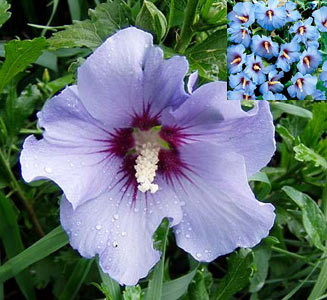 Description: Blue Satin is a great improvement over the popular Hibiscus Blue Bird, with larger flowers, better color, more branching, and an all-around longer show. You'll love these huge 3-inch blooms, with magenta throats and an ivory center complementing the strong royal tones of the petals. The flowers are very uniform in color. Bright, tropical, and festive, they are eye-catching from down the street, and will quickly become the focal point of any garden setting. Blue used to be a difficult color to find in the late-season garden, but with the arrival of Blue Satin, you will be aglow in rich, royal blooms for months on end! Blue Satin is a strong growing, uniform clone with rich color. The shrub is easier to grow and more hardy than earlier Hibiscus as well. Reaching 3m tall and 2m wide, it can be grown as a small tree or pruned to just the size you want for the border, patio garden, or special setting. It is quite well-branched, giving you dozens and dozens of flowering stems. Very tolerant of heat and drought, it is a fine choice for hot, dry spots where other shrubs are not happy. Keep it well watered during growth. Best in full sun, but light shade is acceptable. Hardy in zones 5-9. |
Hibiscus syriacus Blue Satin | details |
| 8. | Bohemia Apple Description: |
Malus Bohemia | details |
| 9. | Blue Spanish Fir Description: |
Abies pinsapo Glauca | details |
| 10. | Bright Edge Yucca, Bright Edge Adams Needle Description: A smaller yucca that only grows to about 50cm tall, but sends up attractive 120cm flower stalks in summer. It has variegated sword-like dark green leaves (30-50cm long) edged with a bright golden-yellow margin and radiating upward from a central crown and remaining upright all year round except in the heaviest snows. It is ideal for modern landscape or large containers and combines nicely with all kinds of mounded foliage plants. Of a more compact nature than other varieties Bright Edge also works well in smaller perennial borders and rock gardens. It is also attractive in mass planting or as an accent plant. Tough as nail, it is the ideal plant for a no-maintenance garden. From early to midsummer, spectacular sturdy flower stalks rise from the center of the plant and hold masses of white bell-shaped flowers. Individual bell-shaped vaxy flowers are 5-7cm long and dangle from the stems like earrings. Drought and salt spray tolerant, it requires sun and medium to dry soil with good drainage. Hardy in Zone 4 to 9. |
Yucca filamentosa Golden Sword | details |
| 11. | Burkwood Viburnum, Snowball Bush Description: Burkwood viburnum is grown in gardens for its early, strongly scented white to pale pink flowers. It is a medium to large upright rounded shrub with semi-evergreen dark-green leaves. In autumn the leaves that are preparing to fall develop vivid yellow and red tones. Pink buds open white in early spring in fragrant clusters 5-7cm wide. 1cm red fruit turns black in summer. The Burkwood viburnum grows in hardiness zones 5-8. Its site requirements are sun to partial shade and it is able to grow on range of soil types. Reaches 2.5-3 metres in maturity. It has a good heat tolerance. |
Viburnum burkwoodii | details |
| 12. | Bergeron Apricot Description: |
Prunus armeniaca Bergeron | details |
| 13. | Boston Ivy Veitchii, Red-leaf Boston Ivy, Veitch's Boston Ivy, Japanese Creeper Description: This variety of Boston ivy has shallow-lobed leaves, creating a jagged appearance. It is an excellent clinging deciduous vine which is most well-known for its amazing autumn foliage colours. Rich and intense hues of scarlet, fiery purplish red, yellow and orange light up with the onset of autumn. After the leaves fall, the dark blue berries remain decorative until they fall. Will tolerate the dust, pollution and exhaust fumes of a city environment very well, making it an ideal choice for a wall or fence covering in your city garden. It makes a much more decorative plant for a wall or pergola than the normal species Parthenocissus tricuspidata, which has only plain three-lobed leaves. It's pretty vigorous, so give it space to spread where it will provide useful habitat for insects and small birds, too. Veitchii makes a good textured covering for any large sunny surface, and can even be used in a large garden as ground cover among shrubs, when it will root at each leaf joint and scramble over them. Will adapt to a wide range of growing conditions but prefers moist, well-drained soil in full sun or partial shade. It can reach height 18m and spread 4m in maturity. It is therefore very well suited for high houses and blocks of flats. |
Parthenocissus tricuspidata Veitchii | details |
| 14. | Blackberry Otelo Description: |
Ribes nigrum Otelo (Ottelo) | details |
| 15. | Big Purple Rose (blue-violet) Description: The large flower has an attractive, well formed shape and is a very striking, deep beetroot-purple supported on a strong upright bush. A hardy and disease resistant rose with no special requirements other than a sunny position with well drained soil. Suitable for bedding or border. Repeat Flowering. Good For Cutting |
Rosa Big Purple | details |
| 16. | Big Betony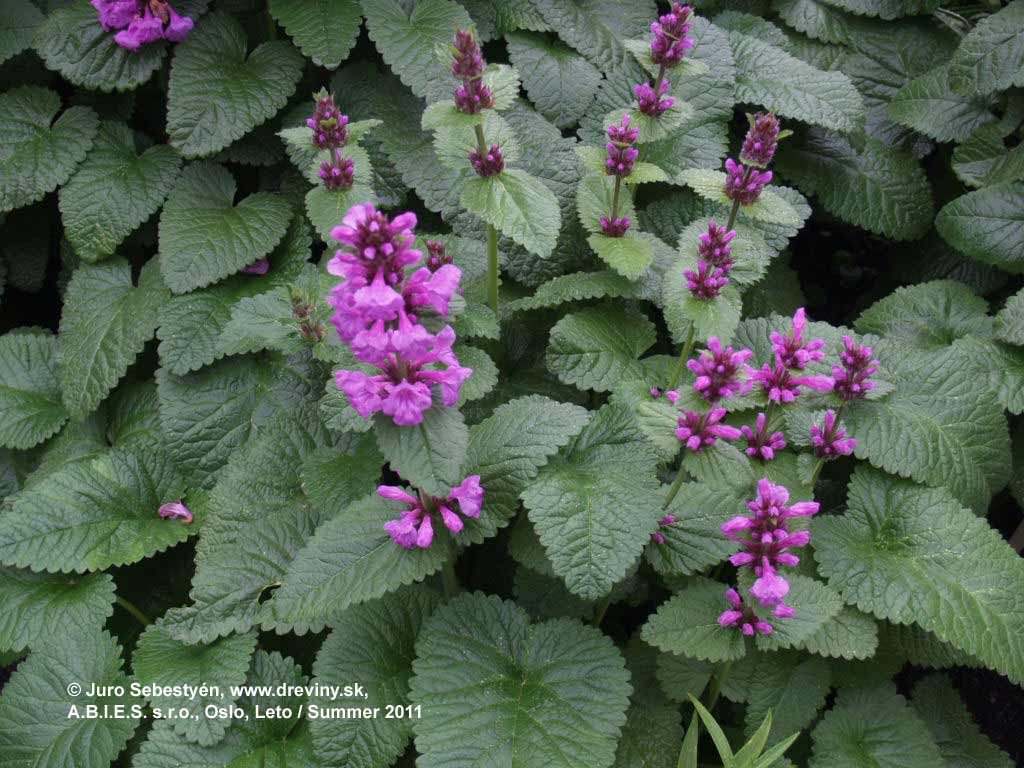 Description: Má atraktívne ružice srdcovitých, na okraji vrúbkovaných listov, od začiatku leta sa rozvíjajú klasy ružovo purpurových kvetov s dlhou rúrkou. Rastie na slnku a v polotieni. Dorastá do výšky 45cm. |
Stachys macrantha | details |
| 17. | Blue Bird Plantain Lily, Hosta, Funkia Description: |
Hosta hybrid Blue Bird | details |
| 18. | Bianka Wine Grape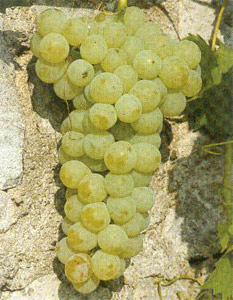 Description: |
Vitis vinifera Bianca (Bianka, Blanka) | details |
| 19. | Bugleweed Description: This perennial is excellent groundcover. Ajuga is suitable also for rock garden. It has spiky blue flowers and white-silver-green leaves, in winter and cold they change color into purple-pink. Ajuga blooms from april to june. It reaches height of 15cm and spreads quite easy on sites. We use 9-12pcs/ m2. It requires soil with pH 6,0. It likes sunny to semi-shadow place. The best conditions you can give it, is the morning sun, the rest of the day only shadow. Ajuga reptans is very nice in composition with grasses (Acorus), salvia (Salvia Icterina), chryzantema and Gentiana. This perennial is partialy evergreen. |
Ajuga reptans Burgundy Glow | details |
| 20. | Blue Glow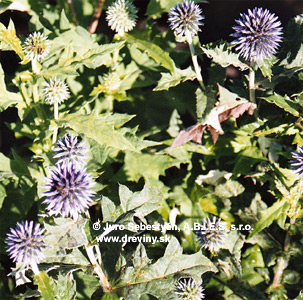 Description: Blue Glow is a garden work horse thriving in many different climates and in just about any soil. This perennial has deep green, thistle-like foliage and flowers reliably in mid-summer (july-august) with numerous intensely blue, globe-shaped flowers. Can grow up to 90cm. |
Echinops banaticus Blue Glow | details |
| 21. | Black Mondo Grass Description: Black Mondo Grass is slow-spreading, clump-forming grass with narrow purplish-black leaves. Bell-shaped, pink flowers appear in the summer and provide an excellent contrast with the dark leaves. Grow it in rich, medium wet, well-drained soil. Provide consistent moisture and do not allow soil to dry out. This unusual grass will add a point of interest to your garden. Exposure on full sun or partshade. Height is 15cm. |
Ophiopogon planiscapus Nigrescens | details |
| 22. | Buttercup Winter Hazel Description: A dense, widely spreading, deciduous shrub native to Japan and Taiwan, that provides beautiful late winter to early spring bloom in the landscape. Although not overly ornamental, it is a good addition to shrub borders or woodland gardens. It also teams well with rhododendron and azaleas, requiring same growing conditions. This small Japanese shrub grows 180cm tall and spreads 210cm wide. Pruning is not necessary. Its bark is light gray-brown, smooth, becoming a bit scaly with age. In early spring it featuers small drooping clusters of fragrant pastel or buttery-yellow blossoms. Each raceme usually has 2-5 flowers that give way to rounded, veined and toothed, 7cm long green hazel leaves. In spring each leaf is thinly fringed in reddish-purple, though this lovely coloration usually fades as the new leaves age into summer. Its late autumn leaf colors are yellow or brown. I grows an inconspicuous two-beaked capsule, with each cell containing two small seeds. This lovely shrub deserves space in a sunny or lightly shaded part of the garden where its blooms will be protected from spring frosts. Thrives in acidic, light but organically rich, medium moisture, well-drained soils. Tolerates average garden soils, but not unamended heavy clays. The pH preference is 4,5 to 6,5. It grows well in temperature zones 6 to 8 and can not be therefore planted in cold mountain areas. |
Corylopsis pauciflora | details |
| 23. | Blossom Time Climbing Rose, Blossomtime Climbing Rose Description: Blossomtime is a large flowered medium pink climber rose bred in United States (1951) by Conrad O'Neal. It is very adaptable and copes well with any training or pruning. The flowers are very large - 9 cm in diameter, fully double with 38 to 65 petals. They are intensely fragrant and their wonderful scent reminds of old roses. Flowers develop repeatedly during months of June to August from oval deep pink buds and grow in clusters of 3 to 8. Their colour is a combination of two shades of china pink. Flower buds are high centred and fragrant. It produces well-spaced clusters all season long; the flowers are accented by the contrasting foliage of glossy bronze green. On support the plants grow up to 2-4.5 m high. The Blossomtime rose can be used as ground cover and also for producing cut flowers. It grows well in temperature zones 6b - 9a covering most of the Central Europe with exception of higher mountains. It prefers position in full sun but tolerates also shade. |
Rosa Blossom Time (Blossomtime) | details |
| 24. | Blue Angel Holly on 95-110cm stem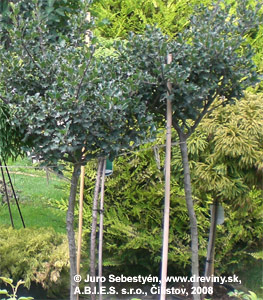 Description: Compact evergreen balls with violet branches. If left unpruned they will grow 100cm high in 10 years and 250cm high in maturity. Blue Angel is a female variety producing a good crop of bright red berries when pollinated by a male holly. Pollen of the male Blue Prince variety is carried by the wind to a distance up to 70 km therefore the pollination should succed in your garden even without your own pollen donor. It is grown primarily for its dark purple stems and crinkled blue-green glossy leaves turning deep blue-purple in winter. The leaves are armed with decorative thorns. It forms a slow growing evergreen shrub. Unpruned it becomes a robust plant that's ideal for hedges and screens, both inland and by the sea, but also makes a good specimen shrub but also can be grown in groups. Also ideal for large containers for patio or terrace use. It is hardy and can by grown by also beginners. We have to plant it into full sun or partial shade and into well drained or sandy chalky (alkaline) or acid soil. The decorative berries together with colourful leaves can be used in floristictics to create wreathes, bouqets and flower arrangements. |
Ilex meserveae Blue Angel | details |
| 25. | Bosc Pear, Bosco Pear Description: The Bosc Pear is medium to large, dark yellow fruit with brownish russeted skin and a long, gourd-shaped neck. It is tender, aromatic, jiucy, smooth textured and white fleshed with a rich, slightly acid flavor that is great for eating, baking and drying. Trees are large, upright, slow growing and late blooming, but are also very productive and reliable. It harvests very late in September. |
Pyrus Bosc | details |
| 26. | Benjamin Mugo Pine, Benjamin Swiss Mountain Pine, Benjamin Mugho Pine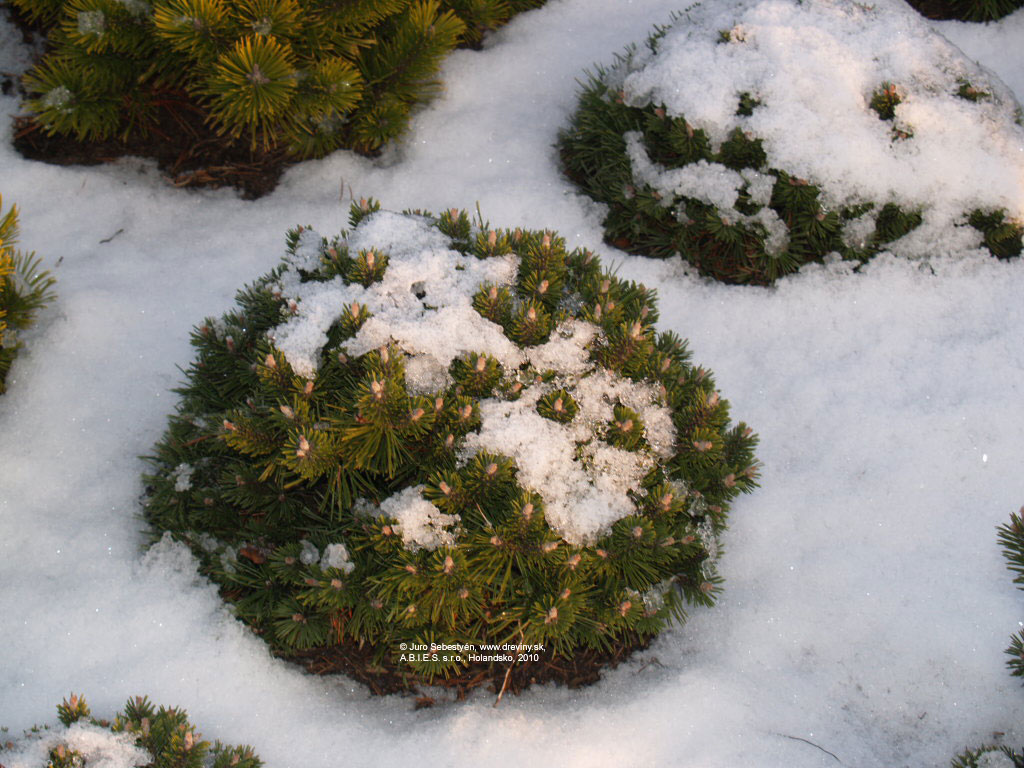 Description: |
Pinus mugo Benjamin | details |
| 27. | Bishop’s Hat, Barrenwort, Fairy Wings Description: Epimedium cantabrigiense is an evergreen spreading perennial. It grows around 30-40cm high and about 100-120cm wide. Its small yellow flowers with a pink tinge appear from April to May. Foliage turns bronze in the fall. It is drought tolerant and deer resistant. Zones 3-9. Should be planted in partial to dappled shade. Epimedium cantabrigiense is virtually pest free. |
Epimedium cantabrigiense | details |
| 28. | Bohemica Apple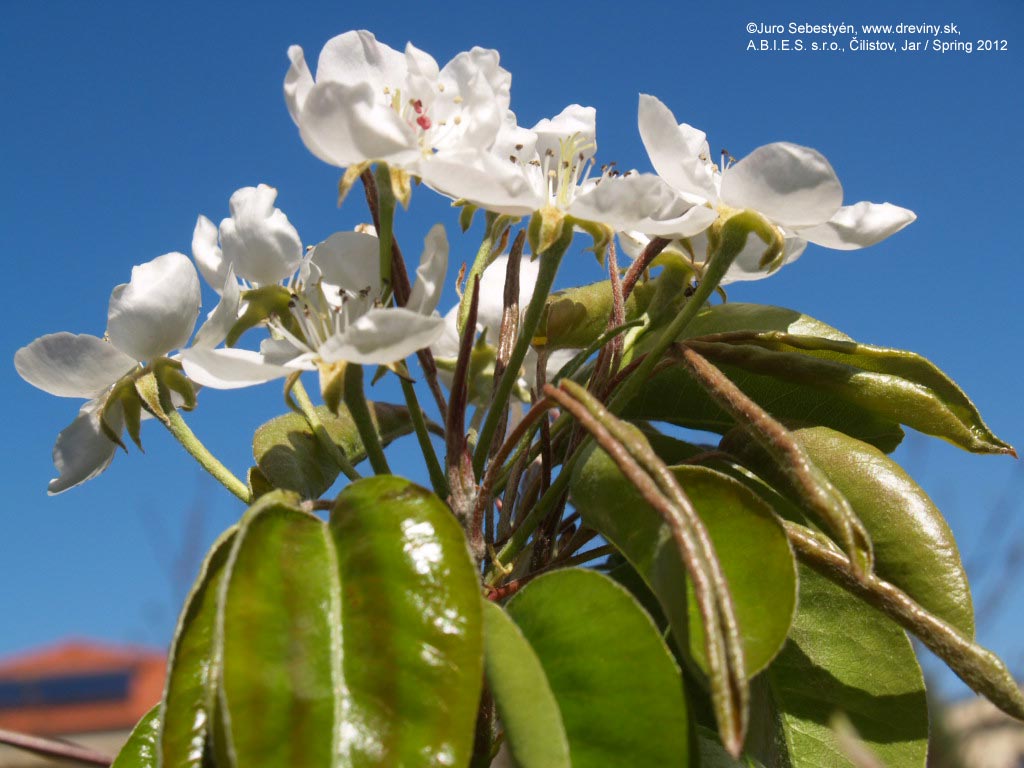 Description: |
Pyrus communis Bohemica | details |
| 29. | Blue Moon Rose Description: Special rose with almost blue flowers, well rooted in 4L pots |
Rosa Blue Moon - | details |
| 30. | Bandai Japanese Cedar Description: The Bandai Japanese Cedar belongs to the most unusual and useful plants for its irregular globular habit which gives the plant an artistic quality of its own. A dwarf cultivar which grows to about 2m tall landscape tree, more upright than mounded. Short clustered and congested dark green needles turn to bronze colour in winter time. Its irregular, wavy upright growth suggesting a windswept look, makes this popular for bonsai or garden planting. It can grow in sunny position or in halfshade. Zones: 6-10. Dense clusters of miniature foliage and winter colour make it a good choice for any garden. |
Cryptomeria japonica Bandai | details |
| 31. | Blondy Wintercreeper on standardDescription: The Blondy wintercreeper is a very useful new dwarf evergreen shrub. It has dramatic, colourful, crisp variegation. Each green leaf has a big clear yellow thumbprint in its center and a thin dark green margin. It grows into a form of compact mounds with mature height and spread from 40 to 60cm. When grafted on standars it establishes small compact canopies. Widely adaptable to broad range of soils, it also grows from full sun to full shade. Thrives best in well drained soil. Beautiful, neat growing shrub with superb hardiness and sunburn resistance. Blondy on standard can be used in front-gardens, as specimen in lawn or rock-gardens or in low broader pots for all year round interest. Zones 5-9. |
Euonymus fortunei Blondy | details |
| 32. | Bigleaf Hydrangea King George V., Mophead hydrangea King George V., Hortensia hydrangea King George V. Description: |
Hydrangea macrophylla King George VII | details |
| 33. | Boskoop Glory Black Grape Vine Description: Deciduous, woody climber with three to five-lobed leaves ideal for training up an arbour and other garden structures. The vine produces good quality dark blue / purple fruit, and is an excellent cropper. As every grape it grows best on well drained soil in a sunny location. It is reasonably good for wine making and has good dessert qualities. Can be grown in pots on the patio. Train over your pergolas or archway for summer shade, followed by burnished orange autumn colour. |
Vitis vinifera Boskoop Glory | details |
| 34. | Buccaneer Wallnut Description: Buccaneer walnut is a Dutch variety suitable for growing on flatlands of Central Europe. It is is both self-fertile and precocious producing large round nuts of good quality and taste from the age of about four years. Later the crops become abundant. A self-fertile cultivar, it produces pollen over a long period and is thus a valuable pollinator for other cultivars. The tree is about the same size as a seedling walnut, it comes into leaf very late and so usually avoids damage by late frosts. It grows to a fairly vigorous upright tree with narrow high open canopy. It is suitable for larger gardens and avenues. They ripen in the 2-nd or 3-rd week of September. Cropping is good and the nuts are particularly suitable for pickling. The tree itself is resistant against bacterial diseases and also well frost hardy. |
Juglans regia Buccaneer | details |
| 35. | Black Poplar Description: |
Populus nigra Italica | details |
| 36. | Black Mulberry Description: |
Morus nigra Pendula | details |
| 37. | Bur Oak Description: Bur Oak is the most bold-textured of the largest Oaks, having a picturesque appearance in the landscape either in Summer fiddle-shaped foliage or Winter semi-corky stem and straight-ridged trunk outline, having the largest acorn of any Oak, and is also one of the most drought-tolerant large trees, with a deep tap root system that penetrates to the depths of the lowered water table. It is used as a large shade tree maturing at about 25 m tall by 20 m wide under urban conditions, but much taller and wider in its native habitat. It has an upright oval growth habit in youth, becoming rounded, spreading, and massive with age. Its growth rate is slow to medium. Grows best in full sun and is partial shade tolerant in youth. Performs best in moist or dry, neutral or alkaline pH soils, and is very urban tolerant (including tolerance to severe drought, pollution, high pH soils, poor soils, sandy soils, and compacted clay soils) and also adapts to acidic soils. Its leaves are dark green, alternate, strongly obovate. Overall leaf shape resembles a base fiddle or violin. Fall color is yellow-brown to chartreuse and usually poor. Its huge (4 cm long) oval acorn with a thick cap is fringed at the lower end, covering almost the entire nut (hence the common names of Burr Oak or Mossycup Oak), and maturing in a single season. Trunk is gray, very deeply furrowed and grooved with age, forming a very distinctive appearance and contributing to the very bold texture of mature trees. It is native to the Eastern United States, but also naturalized to the Great Plains of the United States (where its thick bark aids in survival during occasional prairie grass fires). It is planted as a shade tree for large lawns, golf courses, parks, open fields, or naturalized areas, including areas that are very dry in the Summer. It is a valuable timber tree attracting wildlife (large birds, deer, and especially squirrels. Very cold hardy (zones 2 to 8). |
Quercus macrocarpa | details |
| 38. | Brevifolia Cedar of Lebanon Description: This endemic tree grows only in one valley on Cyprus. It is one of most beautiful conifers being used in garden design and ladscaping because of its sculpted splendour mostly as an attractive specimen in larger lawns. The top of the Lebanon cedar is broad and flattened in a mature tree. In dense stands of trees it grows straight and narrow, but when standing alone, its lower branches spread out horizontally over a large area and sometimes even rest on the ground. The cedars can grow up to 20 m tall and spread out from 9-15 m. They grow slowly. The oldest tree known is more than 1000 years old. The needles of the Lebanon cedar look like those of larch, except that they are evergreen. In colder climates strong winter frost however burns them from time to time and they drop out in spring before new leaves appear. The needles are grouped in tufts of 30-40. They are a dark blue-green color, and stay attached to the tree for 2 years. The Lebanon cedar doesn't flower until it is 25-30 years old. The cones become 10-12 cm long and stand up straight on the branch. Young cones are light green in color. Female cones are barrel-shaped and dull brown. The Lebanon cedar is not tolerant of strong air pollution. It is however the most cold hardy of cedars as it grows in zones 5-7. Does not tolerate shade but after taking roots grows well also in dry soils. On the first picture in our series - published with kind permission of Dr. Ori Fragman Sapir - you can see also the yellowish male inflorescences. |
Cedrus libani Brevifolia | details |
| 39. | Blue Jeans Leyland Cypress, the quickest growing conifer hedgeDescription: The vegetation of this new clone is bushy and wide: Blue Jeans grows from several branches. It branches well and can show new growth at the base. It grows fast and does not need to be staked if grown in containers. Its blue-green colour is original. Its resistance to cold has been proved in Holland. Blue Jeans is ideal for hedges. |
Cupressocyparis leylandii Blue Jeans | details |
| 40. | Beni Fuji Dogwood Description: |
Cornus kousa Beni Fuji | details |
| 41. | Beard Tongue Description: |
Penstemon digitalis Onyx and Pearls | details |
| 42. | Buddleia davidii White Ball Description: |
Buddleia davidii White Ball | details |
| 43. | Big Blue Liriope Grass, Big Blue Variegated Lilyturf Description: |
Liriope muscari | details |
| 44. | Blue Japanese White Pine Glauca Description: This medium-sized slowly growing cultivar of Japanese White Pine creates a striking landscape element wherever it is used. Its open upright dense habit when young, becomes an impressive wide spreading tree with maturity. It develops into a 10 to 12m tall graceful, pyramidal, irregularly-shaped dense tree, with a spread of 5-7 metres. The 2.5 to 6cm long soft and fragrant needles in spiral arrangement are stiff and twisted, forming glaucous blue/green tufts of foliage at branch tips, and creating an overall fine texture to the tree’s silhouette all year round. The brownish-red cones are 2,5-10cm long and persist on the tree for six to seven years. Scaly, purplish brown bark adds an additional texture to the garden. Pinus parviflora 'Glauca' has the presence to stand alone as a specimen tree and generates interest because its shape differs from the symmetry normally associated with pines. The twisted branches give a sense of age to the tree, even when it is still young. This may be advantageous from a garden design perspective when we want create an established feel already when planting a new garden. USDA hardiness zones: 4B through 7A. Beloved by bonsai growers, but attractive also as specimen or screen. |
Pinus parviflora Glauca | details |
| 45. | Blue Japanese White Pine Glauca Description: This medium-sized slowly growing cultivar of Japanese White Pine creates a striking landscape element wherever it is used. Its open upright dense habit when young, becomes an impressive wide spreading tree with maturity. It develops into a 10 to 12m tall graceful, pyramidal, irregularly-shaped dense tree, with a spread of 5-7 metres. The 2.5 to 6cm long soft and fragrant needles in spiral arrangement are stiff and twisted, forming glaucous blue/green tufts of foliage at branch tips, and creating an overall fine texture to the tree’s silhouette all year round. The brownish-red cones are 2,5-10cm long and persist on the tree for six to seven years. Scaly, purplish brown bark adds an additional texture to the garden. Pinus parviflora 'Glauca' has the presence to stand alone as a specimen tree and generates interest because its shape differs from the symmetry normally associated with pines. The twisted branches give a sense of age to the tree, even when it is still young. This may be advantageous from a garden design perspective when we want create an established feel already when planting a new garden. USDA hardiness zones: 4B through 7A. Beloved by bonsai growers, but attractive also as specimen or screen. |
Pinus parviflora Glauca | details |
| 46. | Buddha's hand, Fingered Citron Description: |
Citrus medica var. sarcodactylis (Digitata) | details |
| 47. | Blue Maid Holly Description: Ilex meservae Blue Maid is an exceptionally hardy and vigorous holy. Its thick and short purplish stems bear a purplish-green evergreen foliage. It is a dense, bushy plant with bright red berries in autumn and winter. We recommend to cover these hollies with a white permeable textile for winter, especially in case of standard grafted and potted plants. |
Ilex meserveae Blue Maid (Made) | details |
| 48. | Brogiotto Bianco Verdino Italian Edible Fig Description: Edible fig is a deciduous shrub or small tree with decorative, large, lobed leaves. Its fruit are figs growing up to 5 cm large, sweet and tender, with pinkish or amber flesh. The main crop, beginning in mid-July, is large; the early - so called breba crop - is small. Immature fruit and branches contain sap which can be an eye and lip-irritant. Trees or shrubs require the protection of a south or east facing sunny wall or fence sheltering them from cold winter winds. They should be preferably planted in moist, free-draining soil in a sunny, sheltered position. However, they will also grow well in partial shade and on almost any type of soil - dry and chalky/alkaline, well-drained and light or in heavy clay or sandy soil. They cannot grow in the shade. A sandy soil that is medium-dry and contains a good deal of lime is preferred when the crop is intended for drying. Highly acid soils are unsuitable. The tree is hardy to zone 7 and can therefore be grown only in southernmost parts in of Slovakia. The top growth is susceptible to frost damage and can be killed back to the base in severe winters, though plants usually recover well. It is in flower from June to September, and the flowers are monoecious (individual flowers are either male or female, but both sexes can be found on the same plant), therefore the plant is self-fertile. The fruit usually takes about 12 months to mature and baby fruits no larger than about 15 mm long in the autumn usually overwinter to form the following year´s crop of fruit. Fruit can be eaten raw or cooked. It is sweet and succulent, a fully ripe specimen is an exquisite fruit that almost literally melts in the mouth. The fruit is often dried for later use. The edible fig grows up to 3,5 m high and 5 m wide in maturity. It is best trained on wires for ease of management, with the roots restricted or braches cut back regularly in every spring. Otherwise plants make more leaf than fruit. Also container cultivation is always successful if pots are dug into ground for the winter period in temperature zone 7. |
Ficus carica Brogiotto Bianco | details |
| 49. | Bulb planter Sneeboer - stainless steel with 63 cm ash wood handle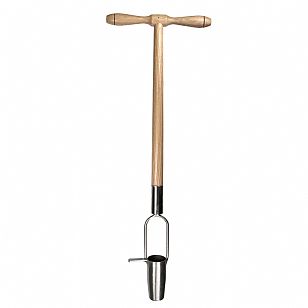 Description: |
details | |
| 50. | Black Chokeberry Description: ple chokeberry, apparently originated as a hybrid of the black and red chokeberries but might be more accurately considered a distinct species than a hybrid. Its leaves are moderately pubescent on the underside. The fruit is dark purple to black, 7–10mm in width, not persisting into winter. The Nero variety produces larger fruit suitable for making wine, jam, syrup, juice, soft spreads, and tea. It is self-fertile - therefore only one plant is sufficient to bear fruit. Its fruits are big, round and slightly flat, black drupes. They are not quite so aromatic as in case of chokeberries growing in the wild but the shrub itself is more fertile and with its height of 1.5m it has been bred for picking fruit by hand. The shrub is very resistant against disease, drought, insects and pollution. Pea-size, black chokeberries taste sweet-sour-bitter - similarly to blueberries - and are picked from August till October. The small drupes are used either dried (like raisins) or in a form of their juice acquired by steam extraction. Thanks to their high content of flavonoids, folic acid and C and K vitamins the chokeberry is considered to be a medicinal plant in Poland and Russia. It has been proven in experiments in vitro that chokeberry fruit extract - due to ist antioxidative properties - significantly reduces the oxidative stress caused by surgery or in different phases of chemotherapy in patiens with invasive breast cancer.[Kedzierska M. et al.: Effects of the commercial extract of aronia on oxidative stress after the surgery and the chemotherapy. Fitoterapia 2011 Nov 12. PMID: 22101070)]. Because of its strong red colour (as a result of its content of anthocyanins) it is also used as a substitute for food colourings. The chokeberries are at the same time attractive ornamental plants for gardens. They are naturally understory and woodland edge plants, and grow well when planted under trees. In the U.S., aronia berries are used in mass-marketed juice varieties for color and marketed for their antioxidant properties. In Poland they are dried to make an herbal tea. Aronia is also used as a flavoring or colorant for beverages or yogurts. Antioxidant qualities of chokeberries are due to their deep purple, almost black pigmentation that arises from dense contents of phenolic phytochemicals, especially anthocyanins. (Source Wikipedia) |
Aronia prunifolia | details |
| 51. | Bolgar Wine Grape, disease resistent Description: |
Vitis vinifera Bolgar | details |
| 52. | Ball of Common Box Description: Stylish ball made of box suitable for romantic and classic gardens or for representative premises. It is also very suitable for border edges and for terraces and balconies. Throughout the year it decorates any area with its fresh green colour of its tiny evergreen leaves. We clip it 1-2 times a year (in spring and / or until the end of September) or more times throughout the season when necessary. It grows best on well drained, light and nutritious soil. Especially in containers by regular watering we try to prevent the soil from drying out completely. In pots or containers it has also to be fertilised each year - preferably with fertilisers having a long period of nutrients release (e.g. Osmocote or Proven Winners brands). We define the final height and spread of the ball ourselves by frequency and intesity of clipping. |
Buxus sempervirens Ball | details |
| 53. | Bamboo Phyllostachys nigra Description: |
Phyllostachys nigra punctata | details |
| 54. | Blue Passionflower Description: |
Passiflora caerulea | details |
| 55. | Bigleaf Hydrangea Madame Emile Mouliere, Mophead hydrangea Madame Emile Mouliere, Hortensia hydrangea Madame Emile Mouliere Description: |
Hydrangea macrophylla Madame Emile Mouliére, Evite Moulliere | details |
| 56. | Bird cherry Description: |
Prunus padus | details |
| 57. | Bronze Veil (Bronzeschleier) Tufted Hair Grass, Bronnze Veil (Bronzeschleier) Tussock grass Description: |
Deschampsia caespitosa Bronzeschleier | details |
| 58. | Besy Common Grape Vine, Besy Common Grape Vine Description: |
Vitis vinifera Besy | details |
| 59. | Bojar Edible Chestnut Description: The Bojar edible chestnut is an early variety selected by the Slovak Fruit Research Institute in Bojnice from a natural chestnut population. It produces regular and abundant crops of large, broad, dark-brown and shiny fruit. Their average weight is between 10-11 grams. The fruit core does not have deep fissures. In Middle Europe the fruit ripens in the first half of October and crop yields between 60-80 kg can be reached. The trees of this variety grow quickly a develop thick cylindrical crowns. They flower late - at the end of June and therefore are not damaged by late Spring frosts. They can be well wind-pollinated. The trees themselves are very healthy and resilient against pests. They do not require any special soil treatment or chemical protection after being planted beside regular summer watering 2-3 times a week during hot summer months. They are not able to grow on highly alkaline soils but flourish on acidic and neutral soils. The Bojar variety has long and large dark-green oblong leaves changing their colour to yellow in autumn. In spring it produces small spikes of cream-yellow flowers. Throughout the summer they develop into edible fruit with peelable shell. The fruit tastes best after being slightly cut on surface and baked in oven. We try to plant them in a sunny position. They prefer sandy, well-drained soils rich in humus. After being established they resist even prolonged periods of drought. In highly alkaline (chalky) soils they are only able to survive if several shovels of acid peat are dug into soil around their stem annually. The flowers are pollinated by insects and wind and mostly need cross pollination. The size of chestnut pollen (14-18 microns) permits the transportation of appreciable amounts at distances of about 100 km. However, the information about who will pollinate whom in the world of chestnut hybrids is difficult to come by; therefore we suggest pairing at least 2 trees of similar origin. Edible chestnuts are able to withstand the winter frost up to the areas with average lowest winter temperatures dropping down to -34 degrees Celsius. At higher altitudes we nevertheless plant them on protected sites. |
Castanea sativa Bojar | details |
| 60. | Blackthorn, Sloe Description: |
Prunus spinosa | details |
| 61. | Blue Fountain Bamboo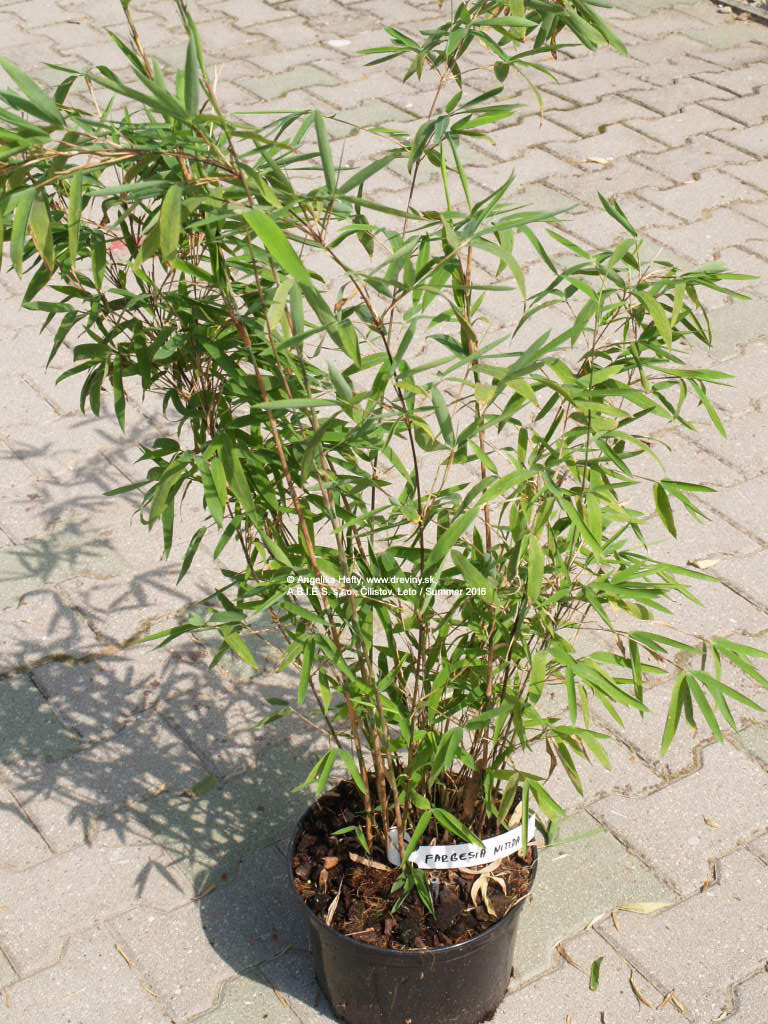 Description: A very cold-tolerant clumping evergereen bamboo found at altitudes up to 3000 metres on the northern sides of Himalaya mountains. Fargesia nitida is a dainty, graceful, thin bamboo with a very vertical visual pattern, upright and slightly arching at the tips. The foliage seems to float around the whip-like culms. These long, blue, arching culms with tiny leaves make this bamboo a beauty. It survives winter temperatures up to -28°C and prefers a position sheltered from cold winds. It spreads on average to about 1m and grows to a height of 2-3m, after several dozens of years even to 4m. It can grow on sunny places, in semi-shade or in shade. Requires moist soil. The canes can be used as plant supports, they can also be woven into hurdles etc. and used in basket making, sieves, light construction and fencing. The plant makes a good dense shelter hedge or screen. |
Fargesia nitida | details |
| 62. | Bergeron ApricotDescription: |
Prunus armeniaca Bergeron | details |
| 63. | Bloodgood Japanese Maple Description: This is a small tree with exceptionally deep, red-purple foliage turning brilliant red in Autumn. The leaves have five main lobes and two minor ones at the base of the leaf: the colour is retained throughout summer with little change in the autumn. Newer wood on stems is a dark red, almost a purple-red and most noticable in the winter when combined with the form of the tree. Excellent branching architecture and smooth bark. It is an elegant and popular maple with a moderately slender upright habit of growth. Vigorous growing allows it to develop in to a tree of usable size quickly. The red-purple fruits are long-lasting and hang in clusters under the foliage. Prefers part shade and in this siting develops it's best form and retains the highest foliage quality. But it is still best for holding its red-purple foliage color all Spring and Summer when placed in full sun, lightening to a vibrant red-orange in Autumn. Try planting this maple against a dark background in a site which receives some direct sun so that the leaves shine brightly and show off their incredible richness against another deep colour. It is often used as a specimen, patio or lawn tree. The height is 5m and it spreads 3.50 m. It stands fully hardy conditions, must be on sun or half shade. |
Acer palmatum Bloodgood | details |
| 64. | Brogiotto Bianco Verdino Italian Edible Fig Description: Edible fig is a deciduous shrub or small tree with decorative, large, lobed leaves. Its fruit are figs growing up to 5 cm large, sweet and tender, with pinkish or amber flesh. The main crop, beginning in mid-July, is large; the early - so called breba crop - is small. Immature fruit and branches contain sap which can be an eye and lip-irritant. Trees or shrubs require the protection of a south or east facing sunny wall or fence sheltering them from cold winter winds. They should be preferably planted in moist, free-draining soil in a sunny, sheltered position. However, they will also grow well in partial shade and on almost any type of soil - dry and chalky/alkaline, well-drained and light or in heavy clay or sandy soil. They cannot grow in the shade. A sandy soil that is medium-dry and contains a good deal of lime is preferred when the crop is intended for drying. Highly acid soils are unsuitable. The tree is hardy to zone 7 and can therefore be grown only in southernmost parts in of Slovakia. The top growth is susceptible to frost damage and can be killed back to the base in severe winters, though plants usually recover well. It is in flower from June to September, and the flowers are monoecious (individual flowers are either male or female, but both sexes can be found on the same plant), therefore the plant is self-fertile. The fruit usually takes about 12 months to mature and baby fruits no larger than about 15 mm long in the autumn usually overwinter to form the following year´s crop of fruit. Fruit can be eaten raw or cooked. It is sweet and succulent, a fully ripe specimen is an exquisite fruit that almost literally melts in the mouth. The fruit is often dried for later use. The edible fig grows up to 3,5 m high and 5 m wide in maturity. It is best trained on wires for ease of management, with the roots restricted or braches cut back regularly in every spring. Otherwise plants make more leaf than fruit. Also container cultivation is always successful if pots are dug into ground for the winter period in temperature zone 7. |
Ficus carica Brogiotto Bianco | details |
| 65. | Blue Noble Fir Description: Procera is one of most favorite firs, the thick heavy textured extremely blue foliage sets it apart. Perhaps the bluest noble fir with the short, densely arranged powder-blue needles The curved, bluish needles grow upright on the twigs and are definitely parted on the undersides of the twigs. The tree itself has a fine horizontally branched pyramidal habit. Limbs are horizontal with purple male stamens. The female cylindrical cones are the largest of all Abies species. They stand straight up and are 20cm high and 7cm thick. They are green at first and then turns a purplish brown. The tree grows in moist deep soil where it can reach a height of 10-20m or can become a large shrub if leader is removed. Water moderate to regular. Partial to full sun. Growth rate slow 2-2.5m in 10 years. Zone 5. Hardiness : -25 degrees C and more. Prefers deep, rich moist soil - not suitable for chalk. Needs a plentiful supply of water, but will not stand being water-logged. Can be trained to form a bonsai. |
Abies procera (nobilis) Glauca | details |
| 66. | Box elder, Boxelder maple, Manitoba maple or Ash-leaved maple Description: |
Acer negundo | details |
| 67. | Black Sun Plum Description: |
Prunus salicina Black Sun | details |
| 68. | Blue Compact Japanese Pine Tempelhof Description: The Japanese pine originates from japanese mountains where it grows in altitudes of 2000 metrov and higher. The Tempelfhof variety is often compared appearance wise to Pinus parviflora Glauca but has a reputation of being a stronger grower. Thanks to its upright habit it can be planted also in smaller gardens. It is a narrow pyramid pine with short five-needled bundles that are much bluer than most varieties. Their also have silver undertones in their colour. We can expect this small moderate growing tree to reach to 3-4 metres in eight to ten years. The height and spread of this pine can vary depending on soil type and prevailing climate conditions. However, over the course of time, it can reach a height of around 10 - 12m and a spread of approximately 5-7m. It prefers sunny locations and light, well-drained and also poor soils, not too cold and dry, without to much lime. Zone 4-8. Perfect for bonsais. |
Pinus parviflora Tempelhof | details |
| 69. | Blue Prince Meserveae Holy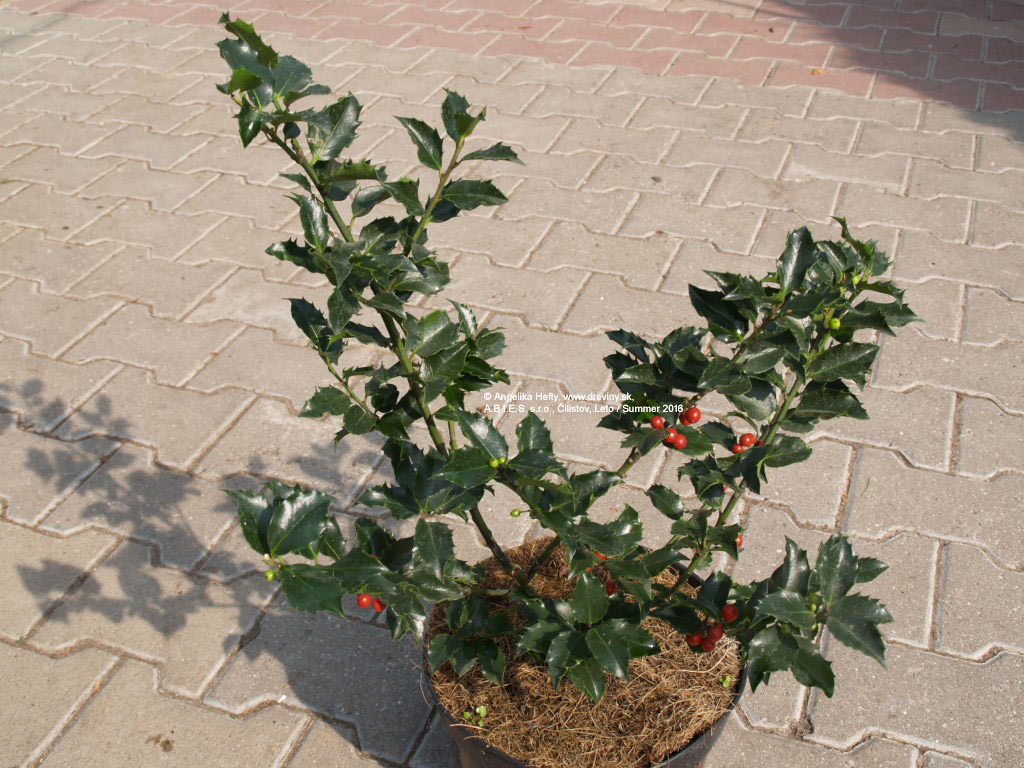 Description: |
Ilex meservae Blue Princess | details |
| 70. | Buddleja davidii Butterfly Candy Ruby Description: |
Buddleja davidii BUTTERFLY CANDY RUBY | details |
Last update on:
07.11.2026 17:10:02
10% discount | Hedging plants | Climbing shrubs and plants | Trees, shrubs and bushes for half-shade | Plants for shade | Bonsai plants | Flowering plants | Plants for terraces and balconies | Evergreen plants | Miniature plants growing up to 1.5m | Conifers growing up to 1.5 - 3m | Conifers growing higher than 3m | Deciduous bushes | Deciduous plants growing up to 3m | Deciduous plants growing higher then 3m | Fruit trees and bushes | Perennials | Ground covering bushes and perennials | Trees and shrubs with ornamental fruit | With beautiful autumn leaf colour | Discounts | Having interesting winter colour or shape | Plants for acid soils | Plants for alkaline soils | Grasses | Bamboos | For rock gardens | Woody plants to lakes and streams | Water plants | Healing and aromatic plants | Citruses | Supplementary goods | Bulbs | Small trees up to 5m wide, for small gardens | Fertilizers | Christmas trees | Fruit trees | Herbs | Multi-stemmed trees |
Naši partneri:
Odborné preklady a tlmočenie, aj úradné, Bratislava
www.kochlik.sk - kvetináče
www.zavlahy-soos.sk - zavlažovacie systémy
soulbridge.sk
www.kochlik.sk - kvetináče
www.zavlahy-soos.sk - zavlažovacie systémy
soulbridge.sk
www.rastliny-semena.sk - ponuka semien a osív
www.agellus.sk - trávnaté koberce
www.eshop-kvetinace.sk
www.agellus.sk - trávnaté koberce
www.eshop-kvetinace.sk


Webstránky vytvoril www.Aweb.sk - tvorba web stránok
VITAJTE V NAŠOM ZÁHRADNÍCTVE!
PREDAJŇA ČILISTOV SHOP - otvár. hodiny / open. hours:
Po-Pia / Mon-Fri 8:00-17:00
So/Sat 8:00-16:00