30 rokov ABIES - Ďakujeme všetkým našim priateľom, rodine, zákazníkom, partnerom za doterajšiu spoluprácu a spoločný rast.
Záhradníctvo ABIES®, Labutia 18, 931 01 Šamorín, časť Čilistov
 |
 |

30 rokov ABIES
e-mail: dreviny@dreviny.sk
+421 948 937 895 (Sale of Plants)
+421 948 877 888 (Garden Design and Landscaping)
+421 903 769 164 (Sale of Plants, Landscaping)


| search on: D | records:38 |
| 1. | Discovery Apple Description: |
Malus Discovery | details |
| 2. | Dwarf Iris, Rock Garden Iris Description: |
Iris reticulata Joyce | details |
| 3. | Dwarf Globe Japanese Cedar Description: This is the best of the globe-shaped cryptomerias with rich green branches, prized for its tidy appearance. This small growing globular shrub is an ideal addition to any garden. Like people, the tree and its lower regions thicken with age. Growth is fast when tree is young and slower as it ages. Clothed right to ground level. The dense blue-green needles on these trees or shrubs often turn bronze in winter. Drooping branch tips look like fingers and are dotted with globe-shaped cones. You could plant a yard of these, and throw away the hedge clippers! A 10 year-old plant should reach approximately 1-2m heigth x 1-2m width. Grows best in sun or partial shade. Prefers acid soil. Use in rock gardens, containers, in foundation planting where low maintenance is desired. Stands all extremes of growing conditions but especially good in high rainfall areas that are well drained. Zones 6-9. |
Cryptomeria japonica Globosa Nana | details |
| 4. | Dwarf Globe Japanese Cedar on 40cm Stem Description: |
Cryptomeria japonica Globosa Nana | details |
| 5. | Danse de Feu Rose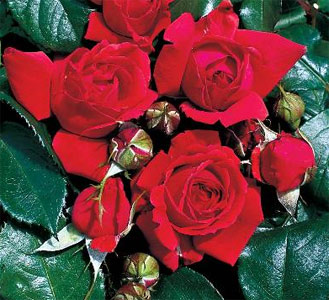 Description: Robust climbing rose bearing double orange-red flowers 10cm in diameter throughout Spring and Autumn. They are very fragrant and their scent reminds of citrus fruit. At the beginning they are ball-shaped and later more loose. This rose has dark green foliage and grows to 4m high and 3m wide. It is great for growing up the side of your house or a stone wall which receives good sun exposure. It is also fully hardy and benefits greatly from regular deadheading during the flowering season. Cutting flowering stems right back in June will also help to keep the plant neat and tidy. |
Rosa Danse de Feu | details |
| 6. | Dame de Coeur Red Rose Description: |
Rosa Dame de Coeur | details |
| 7. | Dovastonii English Yew, Dovaston's Yew , Westfelton yew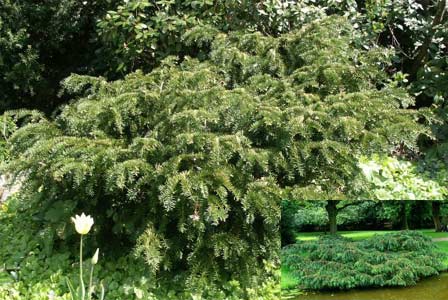 Description: A wide spreading small tree or bush with horizontally held branches, that are weeping at their tips and can spread also on the ground. It can have mostruous, bizarr shape and can be trained on a single stem to make an elegant, spreading, ultimately vase-shaped tree. It has dark green leaves up to 3.5 cm long having an interesting colour in September. After being established the Dovaston´s yew is able to grow also in dry soils which can be slightly acid to strongly alkaline. In general it prefers chalky soils and can tolerate both shady and sunny conditions. Thrives best on places protected from strong winds. It is a low-maintainance tree with a very attractive appearance and can be very well combined with other conifers or ornamental plants. We have to prune it only if want to limit its growth. The original tree was bought by John Dovaston, who in 1777 paid sixpence for a seedling in the hope that the roots of the tree would hold the soil in place round the mouth of a well he had dug. The Dovaston´s yew is most often grown as a specimen in gardens, parks, cemeteries, big courtyards and larger containers. It can be however also platend as foundation, hedge or grouping plant. It produces small red ornamental berries but we have to bear in mind that the whole plant is toxic. It grows up to 2m high and 3m wide in 10 years and old plants can reach a height of 5-7m and spread of 10m, exceptionally 10m and 30m respectively. Zone 5 to Zone 7 |
Taxus baccata Dovastoniana Aurea | details |
| 8. | Dropmore Scarlet Brown's Honeysuckle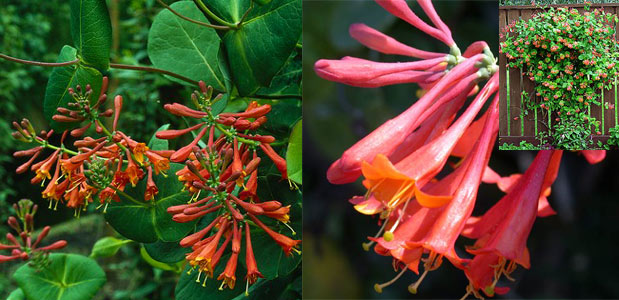 Description: Bred in Canada, this vining honeysuckle is very winter hardy and easy to grow. It has loads of beautiful fragrant scarlet-orange, tubular flowers from June to first frost. Oval blue-green leaves contrast well with flowers. It grows to 3-4m high and wide. Easy to grow in fertile, well-drained soil. Does best in at least a half day of full sun in consistently moist, organic soil. Be sure to give it a support to climb on right away or soon after it's planted. Can be used to cover a trellis, arch, post, fence, pergola or tree. Can be pruned after flowering. To keep it tidy remove old wood. Hardiness: Zones 4-8. |
Lonicera brownyi Dropmore Scarlet | details |
| 9. | Debbie Japanese White Pine Description: |
Pinus parviflora Debbie, Pinus pentaphylla Debbie | details |
| 10. | Dwarf Swordleaf Inula Description: |
Inula ensifolia | details |
| 11. | Diamond Ice plant, Diamond Stonecrop Description: |
Sedum spectabile Brilliant | details |
| 12. | Dinosaur Food, Giant Gunnera, Giant Rhubarb Description: This is one of the largest herbaceous perennials in the world growing over 2 meter tall with wider spread. A single leaf can reach 2.5 meter in diameter. Leaves are shaped to direct rain water to its roots. They are also exceptionally long, up to 3.4 m, borne on thick, succulent, prickly leaf stalks (petioles) up to 2.5 m high. A real show stopper in any garden. Origin: Tropical high elevation cloud forests of Costa Rica, Brazil, and Columbia. Zone Range: 7-10, can be grown therefore only on southern part of Slovakia. Though considered hardy in zone 7, Gunneras grown in zones 7-8 need special care in order to survive winters by cutting down all greenery in late October to 30 cm of the root ball then placeing a thick layer of dry mulch over the crown for the winter. The mulch should be kept dry by a tarp or other rain proofing material. Remove mulch when last spring frost is past. Easy to grow. Plant growth after their first winter is incredible. Preferred Situation: Even temperature; evenly moist to boggy fertile soil. Authors differ in their opinion on Gunnera´s light requirements, some of them recommend ful sun, others part or dappled shade. Truth is probably, that it can flourish on both of these locations. When planting it, one successful approach is to fill a large planting hole with a mixture of loam and well-aged manure. Gunneras are heavy feeders and require a continual supply of water, however the crown must remain above water. Gunnera is suitable ground cover for parks or larger gardens. It is often used as an excellent excellent focal point beside ponds, lakes or streams. The coarse texture and size of this plant dictates that it be given ample room to sprawl. Flowers appear from July to August close to base of plant and resemble a corn cob. Small, delicate plants will be completely lost next to this massive conversation piece. pH Range: 5.5 to 7. |
Gunnera manicata | details |
| 13. | Dwarf Balsam Fir Description: Dwarf Balsam Fir is a flat slow growing dense mounded conifer with dark green leaves. It is a lovely hemispherical dwarf, which immediately becoms a focal point in every rockery, heath garden or border. Grows very slowly, 2.5-7.5cm per year and only reaches 60cm height and 120cm width in maturity. Has very short dark green leaves - only 1.5cm long - with two white stripes on the lower side. The foliage is tidy and looks good at all times of the year. Resin and foliage have a typical aromatical balsam scent. Although it will grow in full sun, it will look its best in a brightly filtered sunny situation. Does quite well also in almost complete shade. Fully winterhardy and very adaptable to colder zones (3-5) but sensitive to drought, heat and salt. Prefers wet and colder, moisture retentive soil rich in humus but well drained, slightly acidic or alkaline (chalky). Needs light summer irrigation. Be careful with overwatering as it can cause a root rot. Can be also grown as a bonsai and is often used in Japanase style gardens. Always remove reverting branches. An ideal low maintenance plant widely used in rockeries, on graves or planted in bigger pots and containers. |
Abies balsamea Nana | details |
| 14. | Dortmund Climbing Rose (red) Description: A lively modern shrub rose, this has cherry red single flowers, each with a noticeable white eye. The flowers come in clusters and the rose flowers continuously throughout summer. Occasional repeat later in the season. The rose carries a reasonable mild fragrance. The flowers are complemented by plentiful semi-glossy, dark green, holly-like foliage. The Dortmund rose is armed with thorns and produces decorative orange hips. It grows rose around 2.5m (8ft) high with a spread of 1.8m (6ft) Grows best in sun and part shade. Bred in Germany (1955) by W. Kordes & Sons. Parentage: Seedling × Rosa kordesii Hort. Used for climber or landscape. Can be grown as a shrub. Remove spent blooms to encourage re-bloom. If you neglect to do this you end up with a good crop of hips. Growing: USDA zone 4 to 9. Disease susceptibility: disease resistant and shade tolerant. Needs little care; relatively disease-free and quite hardy. Prune dead wood. " |
Rosa Dortmund | details |
| 15. | Dwarf Russian Almond Description: This Dwarf Russian Almond is one of the most sought after of all flowering shrubs. The upright stems are clothed in masses of superb bright, brilliant double rose red flowers in March-April. These little round flowers appear before the dented dark green foliage turning orange in fall. Almond-like fruit is sometimes produced from flowers but it is harmful if eaten. A must for the early flowering garden. It reaches only 1.5m in maturity and often starts spreading on the ground. It´s frost resitance is remarkable - it survives winters even in regions with average lowest temperature up to minus 45 degrees Celsius. |
Prunus tenella Fire Hill | details |
| 16. | Diamond Groundcover Rose, Diamant, Brilliant Vigorosa, White Sunsation,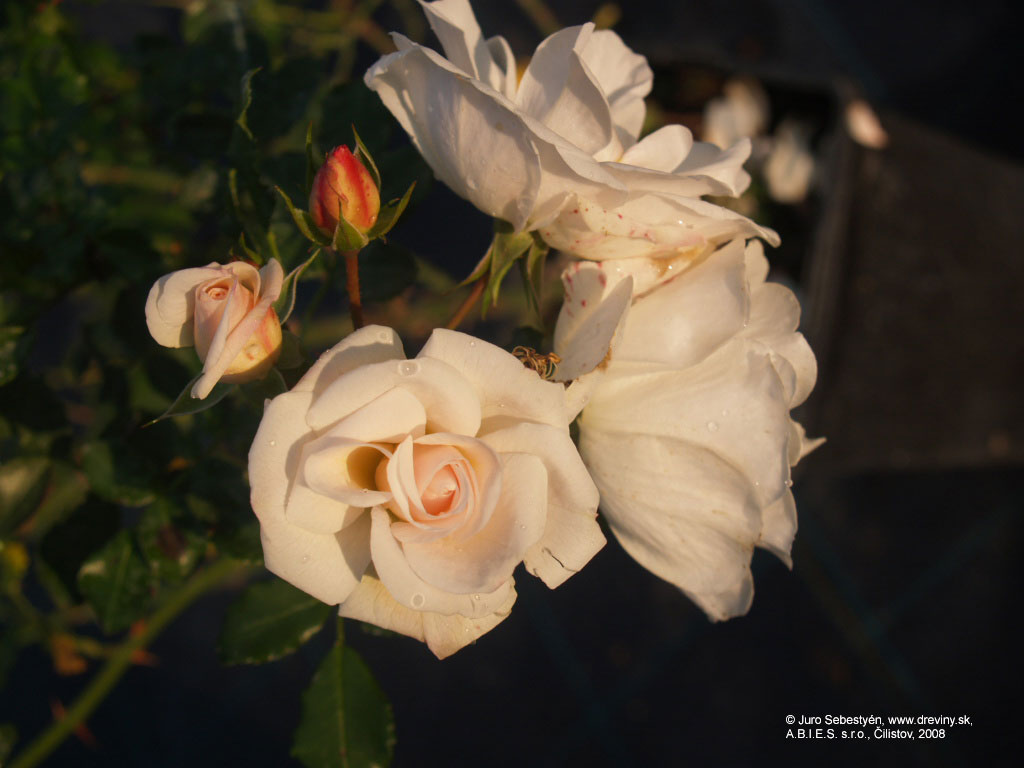 Description: Diamond is a white groundcover rose bred in Germany in 2001 by W. Kordes & Sons. It blooms with white or white blend flowers with slight or no fragrance. They are shining at least the same way as the true precious stone. The flowers are small to medium, semi-double (9-16 petals) with an average diameter of 5,5cm. They appear in small clusters from late spring to first frost. The Diamond rose blooms in flushes throughout the season. It has a medium, bushy, dense, spreading growth habit and small, glossy, dark green foliage. It reaches a height of up to 60 cm in maturity. Grows well in USDA zone 6b through 9b. It is often used in beds and borders, in gardens or as a ground cover. The disease resistance of the Diamond rose has been gradually improved by targeted breeding and became very disease resistant and very blackspot resistant. We have to remove its spent blooms to encourage re-bloom. During the spring pruning we remove old canes and dead or diseased wood and cut back canes that cross. The Diamond rose has good groundcover properties and is appropriate for group and area planting, borders, mixed planting, large beds, small beds, containers and can be even grafted on a full standard or half standard. It reaches a height of 45 cm in maturity. |
Rosa Diamond (Weisser Diamant), Brilliant Vigorosa, White Sunsation) | details |
| 17. | Darwin‘s Barberry, Barberry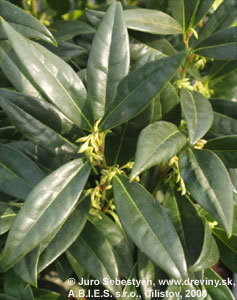 Description: Darwin‘s Barberry is one of the best flowering evergreens. It is a fast growing, thorny shrub with dense branches from ground level, growing up to 3–4 m tall. Darwin’s barberry is native to South America in southern Chile and Argentina. The plant was discovered in South America in 1835 by Charles Darwin during his second voyage of the 'Beagle'. The species was one of many named in honor of Darwin. Its dark, shiny green leaves are small, oval, 12-25 mm long and 5–12 mm broad, with a spiny margin. They are borne in clusters of 2–5 together. The older foliage turns bright red in the autumn. Scented orange flowers appear in April to May. They are 4–5 mm long, produced in dense racemes, and are hermaphrodite (have both male and female organs). The edible fruit is a small, purple-black berry (4–7 mm diameter) ripening in summer. Attracts wildlife. Barberry is perfect for hedging or as a back of border shrub. Ideal also as a specimen where it looks good planted close against a wall. Suitable for container growing. Best located in full sun or light shade. This plant is tolerant of many types of lighter and heavier soil if well drained. It is a tough plant and it is easy to maintain. Tolerates cold exposed locations. Hardy to zone 7. The Royal Horticultural Society has given the species its Award of Garden Merit. |
Berberis darwinii | details |
| 18. | Dwarf-winged Burning Bush, Compact Winged Spindle Tree, Winged Spindle, Winged Euonymus, Compactus Burning Bush Description: Burning bush is a remarkable slow growing, deciduous shrub native to Northeastern Asia, Central China, Japan and Korea. Its dwarf and dense Compactus variety only grows up up to 1.2 to 1.8m high It has an upright growth habit in youth, becoming spreading rounded and horizontally layered with age, and grows up to 2.5 m tall and wide. The stems are notable for their corky ridges or "wings". It features 2-7 cm long, ovate-elliptic dark green leaves which turn bright red in fall. Yellow-green miniature flowers appear in late May and early June, usually inconspicuous and hidden among the expanded foliage. Small green summer fruits are often ornamentally inconspicuous, and they mature to attractive beige-red capsules which split open to form four winged lobes with a bright orange seed at the centre. Burning Bush is usually planted as a single specimen in gardens or in a grove. It can also make a good, natural hedge, screen or shrub border. In architecture it is used to brighten dark corners, or in groves of coniferous evergreens. Easily grown in a wide range of soils that is well-drained, in full sun to part shade. Adaptable shrub which tolerates heavy pruning and urban pollution, as well. It grows in temperature zones 4 to 8. Fully hardy - resinsting frosts up to minus 34 degrees Celsius. The Royal Horticultural Society has given it the Award of Garden Merit (AGM)." |
Euonymus alatus Compactus | details |
| 19. | Dragon´s-eye Japanese Red Pine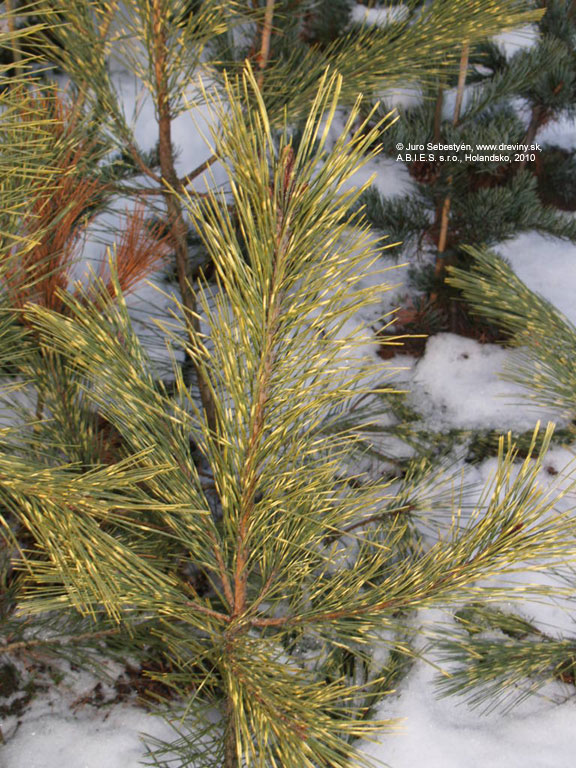 Description: |
Pinus densiflora Oculus Draconis | details |
| 20. | Diane Chinese Witchhazel Description: Hamamelis will tolerate heavy shade, along with deep soil over chalk, but they prefer a peaty, acid, well-drained soil in full sun or dappled shade. In the garden they make ideal specimen shrubs, and are equally suited to group plantings, great where the autumn foliage colour and winter flowers and fragrance can be appreciated. |
Hamamelis intermedia Diane | details |
| 21. | Diana Japanese Larch (on standard 120-130 cm high) Description: |
Larix kaempferi Diana | details |
| 22. | Dublin Bay Rose (climbing red) Description: |
Rosa Dublin Bay | details |
| 23. | De Borggraaf red bush rose in 3L pot Description: |
Rosa De Borggraaf | details |
| 24. | Dutch Elm Description: this picture shows a shaped Dutch Elm as a protection against burning summer sun. Maintainance of his espalier is very simply - only one pruning at the beginning of spring. |
Ulmus hollandica | details |
| 25. | Daisy, Common Daisy, Lawn Daisy, English Daisy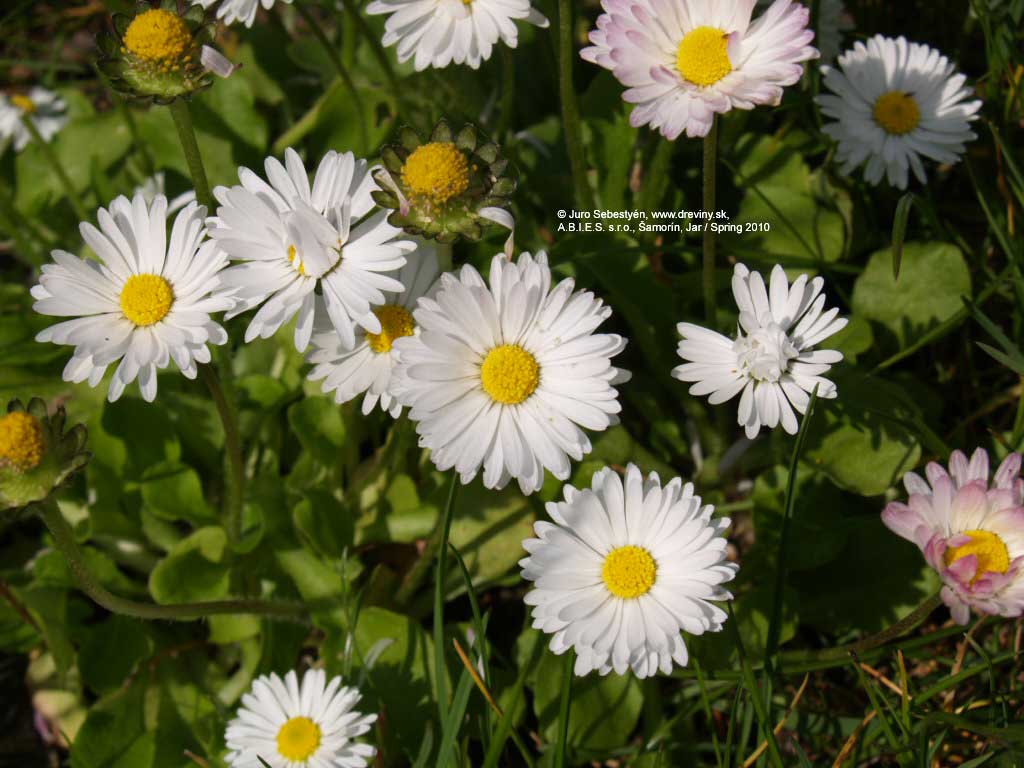 Description: |
Bellis perennis | details |
| 26. | Densa Himalayan Pine, Densa Blue Pine, Densa Bhutan Pine Description: Conspicuous bluish green needles, roughly half as long as those of the Himalayan Pine. |
Pinus wallichiana Densa, syn. P. chylla, P. excelsa, P. griffithii Densa | details |
| 27. | Danica Arborvitae Description: |
Thuja occidentalis Danica | details |
| 28. | Dove Tree, Handkerchief Tree, Pocket-handkerchief Tree, Ghost Tree Description: Dove tree is a moderately fast-growing tree, growing to about 20–25 m in height, with alternate cordate leaves resembling those of a linden in appearance. The Dove Tree is best known for its flowers. These form a tight reddish cluster about 1–2 cm across. Instead of petals each flower head has a pair of large (12–25 cm), pure white bracts at its base performing. These hang in long rows alongside the Dove Tree´s lower branches. The flowers are at their best in late May. On a breezy day, the bracts flutter in the wind like white doves or pinched handkerchiefs, hence the English names for this tree. The fruit is a very hard nut (about 3cm long) closed in a green husk attached to the tree by a 10cm long stalk. It contains 3-6 seeds. The tree itself is cone-shaped when young and rounded with thick branches in maturity. Dove Tree grows in hardiness zones 6-8 and therefore can be planted throughout Europe with exception of the cold mountainous ares. Requires sites in sun or partial shade and prefers moist, well drained soil. At young age Davidia can be helped by mulching and regular watering during dry spells and sheltering from cold winter winds. |
Davidia involucrata | details |
| 29. | Dawyck Purple Beech, Dawycks Purple Upright Beech, Dawycks Common Beech, Dawycks European Beech Description: Dawyck Purple Beech is a deciduous, long-lived tree with a narrowly upright and columnar growth habit that will grow to be about 20m tall at maturity, with a spread of 7m. The tree has significant smooth gray bark and layered branches that curve slightly upwards. It produces a dense mass of foliage that is purple in spring, becomes green-tinged in summer, and finally turns shades of yellow, orange and bronze in autumn. Inconspicuous flowers in spring usually do not result in fruit. Common beech makes a striking vertical landscape accent. It also works well for hedging or screening. Performs best in moist, well-drained, acidic to alkaline soil in full sun. It is somewhat tolerant of urban pollution. Hardy. The Royal Horticultural Society has given it its prestigious Award of Garden Merit (AGM). |
Fagus sylvatica (silvatica) Dawyck Purple | details |
| 30. | Drieň kousa Blue Shadow Description: |
details | |
| 31. | Drummondii Norway Maple Description: Drummondii Norway Maple is a medium sized deciduous tree growing up to 8-12 metres high and 7-9 metres wide. It produces a broadly conical and dense canopy. It has 5-lobed leaves with pointed lobes. New shoots are soft pink. When later leaves start to develop they are light green with symmetrically broad white margins. Drummondii Norway Maple blooms in April. Its flowers are numerous, yellowish green and appear in upright cymes. Fruits are a small, winged and brown, growing in pairs. The tree is undemanding and grows well even on poor soils with exception of wet ones. It thrives best however, in rich, light and slightly moist soils. It is slightly less frost resistant than the original wild Norway maple and therefore more suitable for locations protected from cold winter wind - for example in city centres. It is necessary to remove new purely green shoots (the back mutations) if they appear. |
Acer platanoides Drummondii (Drumondii) | details |
| 32. | Douglas Fir, Oregon Pine Description: |
Pseudotsuga menziesii | details |
| 33. | Dawn Redwood, Shui-hsa, Water fir Description: Metasequoia glyptostroboides (Dawn Redwood) is the only living species in the ancient redwood genus Metasequoia. It is a fast growing deciduous conifer that can get up to 45m tall with a trunk diameter exceeding 2m. Its overall shape is conical, with a single straight bole and rich brown and gold autumnal tints. The leaves are pretty and rather feathery looking being composed of innumerable linear leaflets. These leaflets are 1-3 cm long, arranged in two opposite ranks, and bright fresh green. The needles are deciduous and even the smaller branchlets drop off in winter. In autumn, the foliage takes on a rich orange-brown or coppery color. The trunk is coloured orange-brown and becomes strongly fluted and buttressed at the base. The bark is reddish brown and fibrous, shredding and peeling in long, thin strips. The dawn redwood's massive fluted trunk is especially attractive in winter after the deciduous needle-like leaves drop. Metasequoia was first described as a fossil in 1941, but in 1944 a small stand of an unidentified tree was discovered in China and only finally described as a new living species of Metasequoia in 1948. Dawn redwood has been around for 100 million years, and probably was grazed by dinosaurs. It occurred throughout much of the world until it went extinct almost everywhere several million years ago. Today, dawn redwood grows naturally only in Sichuan and Hubei provinces in west-central China. The tree grows along rivers and around rice paddies where it is planted for soil stabilization. Metasequoia is an easy tree to grow in temperate regions, and is now widely planted as an ornamental tree. Planted specimens have already reached 25-40 m in height and 1-1.3 m in diameter, despite being in cultivation for under 60 years. Dawn redwood does well in normal, well-drained upland soils and also in wet, soggy soils. Once established, they can even survive in standing water. Trees in upland sites need watering during prolonged droughts. If left branched to the ground in full sun, will develop the large, contorted boles that have made it famous. Limbing at an early age will prohibit this formation later on. Dawn redwood is a very fast-growing tree that can reach 15m in height in just 15 or 20 years. It grows best in full sun. Hardiness: USDA Zones 5 - 9. Dawn redwood is a fine, stately specimen for large landscapes such as parks or golf courses. They make excellent avenue trees. Fast growing, with a dense, feathery texture, a stand of dawn redwoods creates an effective summertime visual screen and windbreak in just a few years. Fall color is excellent and even the winter silhouette is very attractive with its massive, fluted trunk and strong horizontal branches. Dawn redwoods are at their best along watercourses or ponds and as they can even tolerate standing water. |
Metasequoia glyptostroboides | details |
| 34. | Decora Pear Description: |
Pyrus communis Decora | details |
| 35. | Dawyck Purple Beech, Dawycks Purple Upright Beech, Dawycks Common Beech, Dawycks European BeechDescription: Dawyck Purple Beech is a deciduous, long-lived tree with a narrowly upright and columnar growth habit that will grow to be about 20m tall at maturity, with a spread of 7m. The tree has significant smooth gray bark and layered branches that curve slightly upwards. It produces a dense mass of foliage that is purple in spring, becomes green-tinged in summer, and finally turns shades of yellow, orange and bronze in autumn. Inconspicuous flowers in spring usually do not result in fruit. Common beech makes a striking vertical landscape accent. It also works well for hedging or screening. Performs best in moist, well-drained, acidic to alkaline soil in full sun. It is somewhat tolerant of urban pollution. Hardy. The Royal Horticultural Society has given it its prestigious Award of Garden Merit (AGM). |
Fagus sylvatica (silvatica) Dawyck Purple | details |
| 36. | Douglas Fir, Oregon Pine Description: |
Pseudotsuga menziesii | details |
| 37. | Deshojo Japanese Maple Description: This upright maple has unusual changing leaf color: pushing brilliant coral red in spring turning to green, with subsequent new foliage throughout the season being red. Deshojo has pastel-red fall color. Provides gardening opportunities for three seasons of accent. |
Acer palmatum Deshojo | details |
| 38. | Durone di Vignola III Fruit Cherry, Nero III di Vignola Fruit Cherry, Bigarreau Tardif de Vignola Fruit Cherry Description: The ancient Italian cherry cultivar Durone di Vignola III produces very large heart-shaped fruit of black-red color, with a firm, crunchy and very tasty flesh of unmistakable taste. The fruit ripens during the first ten days of July. The tree itself grows upright in its youth and later rounds up and reaches a height of 6-10 meters. It is medium-sized, quickly enters fertility and bears regular rich crops. In spring, it blooms profusely with white flowers. The fruit isexcellent for direct consumption as fresh, in fruit salads and are also used in the preparation of jams, syrups and liqueurs, ice creams and yogurt. The Durone di Vignola III Fruit Cherry grows on all types of soils except heavy clayey and permanently wet. It needs a pollinator and its good pollinators are almost all other cherry varieties growing in your area such as Van, Lapins, Kordia, Celeste, Sunburst, Bigarreau Moreau and Durone di Vignola 1 and 2. It is also known as Nero III di Vignola and Bigarreau Tardif de Vignola. |
Prunus avium Durone di Vignola III (Nero III di Vignola, Bigarreau Tardif de Vignola) | details |
Last update on:
07.11.2026 17:10:02
10% discount | Hedging plants | Climbing shrubs and plants | Trees, shrubs and bushes for half-shade | Plants for shade | Bonsai plants | Flowering plants | Plants for terraces and balconies | Evergreen plants | Miniature plants growing up to 1.5m | Conifers growing up to 1.5 - 3m | Conifers growing higher than 3m | Deciduous bushes | Deciduous plants growing up to 3m | Deciduous plants growing higher then 3m | Fruit trees and bushes | Perennials | Ground covering bushes and perennials | Trees and shrubs with ornamental fruit | With beautiful autumn leaf colour | Discounts | Having interesting winter colour or shape | Plants for acid soils | Plants for alkaline soils | Grasses | Bamboos | For rock gardens | Woody plants to lakes and streams | Water plants | Healing and aromatic plants | Citruses | Supplementary goods | Bulbs | Small trees up to 5m wide, for small gardens | Fertilizers | Christmas trees | Fruit trees | Herbs | Multi-stemmed trees |
Naši partneri:
Odborné preklady a tlmočenie, aj úradné, Bratislava
www.kochlik.sk - kvetináče
www.zavlahy-soos.sk - zavlažovacie systémy
soulbridge.sk
www.kochlik.sk - kvetináče
www.zavlahy-soos.sk - zavlažovacie systémy
soulbridge.sk
www.rastliny-semena.sk - ponuka semien a osív
www.agellus.sk - trávnaté koberce
www.eshop-kvetinace.sk
www.agellus.sk - trávnaté koberce
www.eshop-kvetinace.sk


Webstránky vytvoril www.Aweb.sk - tvorba web stránok
VITAJTE V NAŠOM ZÁHRADNÍCTVE!
PREDAJŇA ČILISTOV SHOP - otvár. hodiny / open. hours:
Po-Pia / Mon-Fri 8:00-17:00
So/Sat 8:00-16:00