30 rokov ABIES - Ďakujeme všetkým našim priateľom, rodine, zákazníkom, partnerom za doterajšiu spoluprácu a spoločný rast.
Záhradníctvo ABIES®, Labutia 18, 931 01 Šamorín, časť Čilistov
 |
 |

30 rokov ABIES
e-mail: dreviny@dreviny.sk
+421 948 937 895 (Sale of Plants)
+421 948 877 888 (Garden Design and Landscaping)
+421 903 769 164 (Sale of Plants, Landscaping)


| search on: N | records:23 |
| 1. | Nana Juniper Description: Dwarf Japanese garden juniper is one of the finest groundcover junipers native to southern Japan and Korea. The Nana cultivar is a slow-growing evergreen that will grow to be only about 15–20cm tall at maturity, with a spread of 75–100 cm. It provides a dense mound of branches that radiate from the center, forming an elegant mat. The spiny-pointed foliage is shorter that of the original japanese juniper. It has a scaly-like texture with bluish undersides and develops a lovely purplish cast over the winter. The wild growing shrub produces blue berries from late spring right through to late winter but these are absent on cultivated plants such as Nana cultivar. Dwarf Japanese garden juniper is one of the most widely grown groundcover junipers and is also commonly used in bonsai. It is suitable for rock gardens, mass plantings or for use in raised beds where the branches can trail over the side. This plant grows well in average, medium moisture, well-drained soils in full sun. Adapts to a wide range of soils, but prefers a dryish, sandy soil. Tolerates hot, dry growing conditions. It is highly tolerant of urban pollution and will even thrive in inner city environments. Dwarf Japanese garden juniper grows well in temperature zones 4 to 9. Fully hardy. |
Juniperus procumbens Nana | details |
| 2. | Nana Southern Catalpa, Nana Cigar Tree, Nana Indian Bean Tree Description: |
Catalpa bignonioides Nana | details |
| 3. | Nova Zembla Rhododendron Description: This variety with showy deep red flowers is a standard choice for less than ideal gardening conditions. Anyone fearful of being able to take perfect care of a rhododendron will have no worries with this one. This powerful Rhodie is incredibly versatile and vibrant. It has a mounding upright form with compact foliage. When grown in full shade, it gets a bit thinly leafed and attractively reveals its structure. In a portion of sunlight it becomes densely leafed and sets enormous buds. It develops a stout trunk (or trunks) with thick stems, the bark becoming scaly and very attractive with age. The Nova Zembla hybrid will only be 1.5 to 2.5m in ten years. The huge trusses of blooms are a deep, nearly bluish red, 12 cm wide and attract butterflies. In most cases Nova Zembla blooms in late April through May. This hybrid is cold hardy to minus 25 degrees Celsius, plus tolerant of heat and sun (even if dappled shade for part of the day might suit it better). On sunny locations keep roots cool with a thick layer of mulch. Dense foliage makes good foundation planting or hedge. May be planted as a single accent or grouped in islands around the edges of sparsely canopied trees. Ideal for separating driveways or front yards, especially in woodland gardens. Prefers cooler regions but some protection from winter wind is helpful. Deer resistant. Water regularly during the first growing season to establish a deep, extensive root system. Later water when top 5cm of soil are dry. Provide well drained soil, rich in organic matter. If possible, feed with an acid fertilizer after bloom. |
Rhododendron catawbiense grandiflorum Nova Zembla (Koster) | details |
| 4. | Nozomi Rose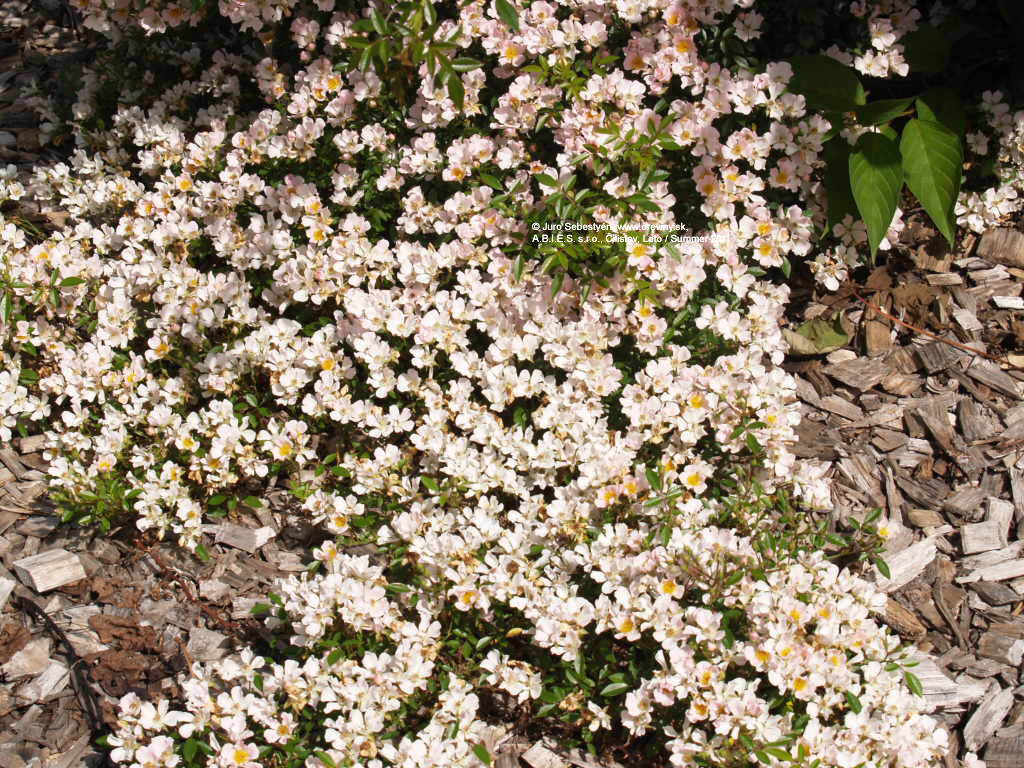 Description: Small spaces require plants in scale with the setting. The Japanese rose ‘Nozomi’, smallest of the groundcover roses, is ideal for rambling about in a rock garden or even a large winterized container. Its amateur breeder Dr. Toru Onodera (1913-2003) created a sensation with the concept of a miniature “groundcover” rose. Nozomi is the most versatile miniature rambler. Single pale pink 2.5cm slightly fragrant blooms that lighten to pearly pink are produced in profusion. Nozomi means hope and was the name of the raiser's niece who died aged four. It spreads almost prostrate, apple green canes over about 120 cm and has one long blooming time, from June to August. More plants together make a lovely show in a corner or surrounding a large boulder, with pearly pink, upward-facing, single flowers that wave tiny anthers. It blooms repeatedly and flowers are slighltly fragrant. Can be grown also in containers, hanging baskets, or as a standard. Without support it reaches height of 15cm and spread of 120cm, on support it climbs up to 120cm a should be planted with a spacing of 1.2-1.8m. It is resistant to black spot, mildew and rust. The blooms are produced on the previous years wood, so only light pruning is recommended. It is a zone 5 plant hardy to -28.8° C. |
Rosa Nozomi | details |
| 5. | National Trust Rose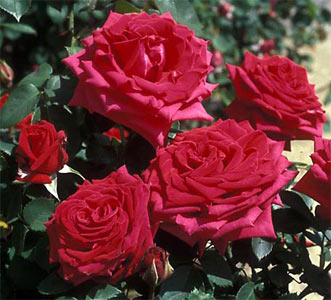 Description: Bush rose with middle-size, very nicely shaped flowers of crimson to scarlet dark red colour. It flowers continuously during the whole season. Grows up to a height of 90cm and width of approximately 60cm. |
Rosa National Trust | details |
| 6. | Nina Weibull (Weybull) Rose bright red Description: Nina Weibull is an undemanding rose, wheather- and winterhardy, proven by a long test of time. It blooms in large clusters of orange red to dark red flowers and grows from 50 to 100cm high. Its strengths are the hardiness and profuse blooms. It is a strong, reliable, free-flowering mid-red rose with light scent or without scent. Blooms in flushes throughout the season from June to frost. The flowers are of middle size and well filled. Nina Weibull has healthy compact growth, strong bush form and abundant branches. It grows very strongly and is almost completely disease resistant. It is one of the most appropriate and most beautiful rose for planting of hedges - for this purpose we plant 3 roses per metre. Bred in Denmark (1961) by Poulsen Roser A/S. Parentage: Fanal × Masquerade (floribunda, Boerner, 1949). In general, floribunda roses are hardy to Zone 6, Zone 5 with winter protection. They require a location in full or partial sun and grow best on moist and well drained and rich soils. We have to prune them in March or April leaving only 3-4 main branches. We remove old canes and dead or diseased wood and cut out canes that cross. When doing so we only leave 2-4 buds on each stem while the last one of them always has to face outward from the shrub. In case of 2-years old and older shrubs in March we cut out one of the old main branches completely to allow the shrub to regenerate regularly. |
Rosa Nina Weibull (Weybull) | details |
| 7. | Nanshan Boer Cotoneaster on standard 80cm high Description: One of the most beuatiful dwarf ground cover varieties grafted on a 80cm high standard to produce a small, weeping tree and to display the bizarre overhanging small branches at their best. Its small bright and shiny green ovate-elliptic foliage resists well the first frosts and the plant remains green for a long periods of Autumn. Numerous white flowers with a pink tinge appear in May or June and are followed in autumn by a flood of orange-red berries which are remarkably big for the species. This cotoneasters is able to grow in most difficult situations and provide garden with winter colour. It can be planted in any soil in full sun or part shade. It is very hardy and can survive temperatures below 26 degress Celsius. Special care is not necessary. Every four years you can make it appear younger by cuting out several older branches. This will help to strenghten the plants health and shape. Ideal for the patio or balcony as its height will always remain the same. |
Cotoneaster praecox (suecica, adpressus) Nanshan Boer | details |
| 8. | Nana Himalayan Pine, Nana Blue Pine, Nana Bhutan Pine Description: "Nana is a dense, dwarf and bushier form of the Himalayan pine. This slow growing variety forms a blue toned densely rounded bush growing as wide as high. To form its attractive shape, it grows about 15cm per year. It has the same long, silver-blue drooping needles as the species. They are three-sided; blue on the two upper sides, green on the lower, creating a very soft and silvery blue appearance. It is native to the mountains from Afghanistan to Nepal, in the 2000-4000m range. Nana Himalayan Pine is a very charming specimen requiring a position in a full sun. Can be grown in temperature zones 5 - 7. With more exposure it will certainly become well known. In maturity it reaches height and spread from 1.5 to 3m." |
Pinus wallichiana Nana, syn. P. chylla, P. excelsa, P. griffithii | details |
| 9. | Nepal Cinquefoil, Cinquefoil, Five Finger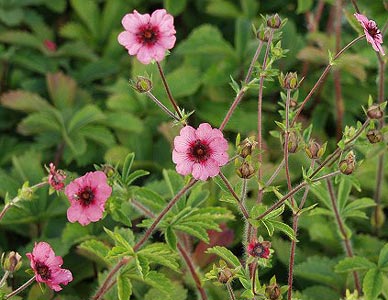 Description: |
Potentilla nepalensis Miss Willmott | details |
| 10. | Nana Variegated Weigela Description: This variegated Weigela enchants you with her mid-green leaves that have a pronounced irregular creamy white edging. This fades quite rapidly to whiter tones and gives the plant a fresh appearance. The tubular flowers start white and take on deeper pink tones later. They open up in months of May till June or also in August. The variegated Weigela can be pruned accordig to our needs. In gardens it provides for an object of architectural interest especially during the season and can grow up to 2m high and 1.5m wide. It requires a position in full sun or half shade. It does not have any special soil requirements. |
Weigela florida Nana Variegata | details |
| 11. | Nana Serbian Spruce Description: Serbian Spruce, like most conifers, has a compact shrub cultivar Nana, which has a slowly expanding globe shape. This cultivar is a densely-branched, slow-growing, dwarf evergreen tree with a globose to broad conical form. Slow-growing form (7-15cm per year) that typically grows 1,5-2,5 tall (infrequently to 3m) over time. Short, dense, glossy, dark green needles (to 1cm long) have white stomatal bands underneath lending a silvery, bicolored effect. Egg-shaped cones (to 5cm long). Grows well in average, medium wet, well-drained soil in full sun to part shade. Prefers moist, rich soils. It has a better tolerance for hot, humid climates and air pollution than most other species of spruce. Plant as a specimen or accent. Can be used for foundation planting, rock garden or borders. |
Picea omorika Nana | details |
| 12. | Norway Maple Description: Norway Maple or Acer platanoides is a large, fast growing, ornamental deciduous tree. It produces rather insignificant yellow flowers in Spring but its glory is its brilliant autumn foliage - shades of gold to red. A good specimen and marvellous for lighting up a predominantly green wood. The Norway Maple grows up to approximately 30 meters with a short unbranched trunk. Resembles a Sycamore but it is smaller and more colourful in autumn. Large, 5 lobed serrated leaves are bright green. Flowers in April. Native to much of Europe, used as a tree in forests and in parks or as a street tree. The opposite five-lobed leaves have several whisker-tipped teeth on each lobe. The buds are fairly large and reddish-purple. The bright yellow flowers appear in erect corymbs before the leaves, making the tree briefly very colourful. The winged keys are at almost 180 degrees to one another. Needs adequate space to develop. Adaptable to many soils (pH from 4,5 to 7,5). It is easily transplanted. Full sun is best. Tolerant of urban conditions. It is frost hardy, zones range from 2b to 7b. |
Acer platanoides | details |
| 13. | Nanshan Boer Cotoneaster Description: One of the most beuatiful dwarf ground cover varieties producing a small bizarre and overhanging branches at their best. Its small bright and shiny green ovate-elliptic foliage resists well the first frosts and the plant remains green for a long periods of Autumn. Numerous white flowers with a pink tinge appear in May or June and are followed in autumn by a flood of orange-red berries which are remarkably big for the species. This cotoneasters is able to grow in most difficult situations and provide garden with winter colour. It can be planted in any soil in full sun or part shade. It is very hardy and can survive temperatures below 26 degress Celsius. Special care is not necessary. Every four years you can make it appear younger by cuting out several older branches. This will help to strenghten the plants health and shape. Ideal for the patio or balcony as its height will always remain the same. |
Cotoneaster praecox (suecica, adpressus) | details |
| 14. | Nigra Black Pine Description: |
Pinus nigra | details |
| 15. | Northern Pecan, Sweet Pecan Description: |
Carya illinoinensis | details |
| 16. | Nero Black Chokeberry Description: ple chokeberry, apparently originated as a hybrid of the black and red chokeberries but might be more accurately considered a distinct species than a hybrid. Its leaves are moderately pubescent on the underside. The fruit is dark purple to black, 7–10mm in width, not persisting into winter. The Nero variety produces larger fruit suitable for making wine, jam, syrup, juice, soft spreads, and tea. It is self-fertile - therefore only one plant is sufficient to bear fruit. Its fruits are big, round and slightly flat, black drupes. They are not quite so aromatic as in case of chokeberries growing in the wild but the shrub itself is more fertile and with its height of 1.5m it has been bred for picking fruit by hand. The shrub is very resistant against disease, drought, insects and pollution. Pea-size, black chokeberries taste sweet-sour-bitter - similarly to blueberries - and are picked from August till October. The small drupes are used either dried (like raisins) or in a form of their juice acquired by steam extraction. Thanks to their high content of flavonoids, folic acid and C and K vitamins the chokeberry is considered to be a medicinal plant in Poland and Russia. It has been proven in experiments in vitro that chokeberry fruit extract - due to ist antioxidative properties - significantly reduces the oxidative stress caused by surgery or in different phases of chemotherapy in patiens with invasive breast cancer.[Kedzierska M. et al.: Effects of the commercial extract of aronia on oxidative stress after the surgery and the chemotherapy. Fitoterapia 2011 Nov 12. PMID: 22101070)]. Because of its strong red colour (as a result of its content of anthocyanins) it is also used as a substitute for food colourings. The chokeberries are at the same time attractive ornamental plants for gardens. They are naturally understory and woodland edge plants, and grow well when planted under trees. In the U.S., aronia berries are used in mass-marketed juice varieties for color and marketed for their antioxidant properties. In Poland they are dried to make an herbal tea. Aronia is also used as a flavoring or colorant for beverages or yogurts. Antioxidant qualities of chokeberries are due to their deep purple, almost black pigmentation that arises from dense contents of phenolic phytochemicals, especially anthocyanins. (Source Wikipedia) |
Aronia prunifolia Nero | details |
| 17. | Nigra Black Pine Description: |
Pinus nigra Nigra (subspecies Nigra) | details |
| 18. | Nero Black ChokeberryDescription: ple chokeberry, apparently originated as a hybrid of the black and red chokeberries but might be more accurately considered a distinct species than a hybrid. Its leaves are moderately pubescent on the underside. The fruit is dark purple to black, 7–10mm in width, not persisting into winter. The Nero variety produces larger fruit suitable for making wine, jam, syrup, juice, soft spreads, and tea. It is self-fertile - therefore only one plant is sufficient to bear fruit. Its fruits are big, round and slightly flat, black drupes. They are not quite so aromatic as in case of chokeberries growing in the wild but the shrub itself is more fertile and with its height of 1.5m it has been bred for picking fruit by hand. The shrub is very resistant against disease, drought, insects and pollution. Pea-size, black chokeberries taste sweet-sour-bitter - similarly to blueberries - and are picked from August till October. The small drupes are used either dried (like raisins) or in a form of their juice acquired by steam extraction. Thanks to their high content of flavonoids, folic acid and C and K vitamins the chokeberry is considered to be a medicinal plant in Poland and Russia. It has been proven in experiments in vitro that chokeberry fruit extract - due to ist antioxidative properties - significantly reduces the oxidative stress caused by surgery or in different phases of chemotherapy in patiens with invasive breast cancer.[Kedzierska M. et al.: Effects of the commercial extract of aronia on oxidative stress after the surgery and the chemotherapy. Fitoterapia 2011 Nov 12. PMID: 22101070)]. Because of its strong red colour (as a result of its content of anthocyanins) it is also used as a substitute for food colourings. The chokeberries are at the same time attractive ornamental plants for gardens. They are naturally understory and woodland edge plants, and grow well when planted under trees. In the U.S., aronia berries are used in mass-marketed juice varieties for color and marketed for their antioxidant properties. In Poland they are dried to make an herbal tea. Aronia is also used as a flavoring or colorant for beverages or yogurts. Antioxidant qualities of chokeberries are due to their deep purple, almost black pigmentation that arises from dense contents of phenolic phytochemicals, especially anthocyanins. (Source Wikipedia) |
Aronia prunifolia Nero | details |
| 19. | Northern White Cedar, Eastern Arborvitae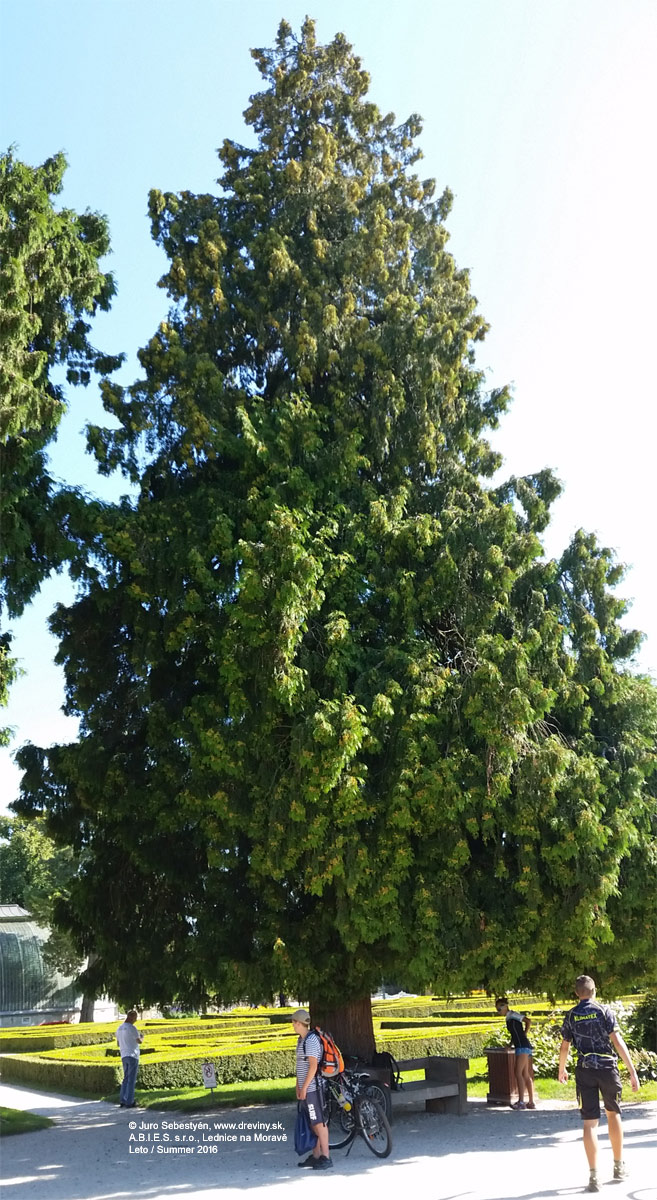 Description: |
Thuja occidentalis | details |
| 20. | Norway Spruce Description: |
Picea abies | details |
| 21. | Negishi Japanese White Pine Description: |
Pinus parviflora Negishi, Pinus pentaphylla Negishi | details |
| 22. | Nero Black ChokeberryDescription: |
Aronia Nero | details |
| 23. | Norway MapleDescription: rway Maple or Acer platanoides is a large, fast growing, ornamental deciduous tree. It produces rather insignificant yellow flowers in Spring but its glory is its brilliant autumn foliage - shades of gold to red. A good specimen and marvellous for lighting up a predominantly green wood. The Norway Maple grows up to approximately 30 meters with a short unbranched trunk. Resembles a Sycamore but it is smaller and more colourful in autumn. Large, 5 lobed serrated leaves are bright green. Flowers in April. Native to much of Europe, used as a tree in forests and in parks or as a street tree. The opposite five-lobed leaves have several whisker-tipped teeth on each lobe. The buds are fairly large and reddish-purple. The bright yellow flowers appear in erect corymbs before the leaves, making the tree briefly very colourful. The winged keys are at almost 180 degrees to one another. Needs adequate space to develop. Adaptable to many soils (pH from 4,5 to 7,5). It is easily transplanted. Full sun is best. Tolerant of urban conditions. It is frost hardy, zones range from 2b to 7b. |
Acer platanoides | details |
Last update on:
07.11.2026 17:10:02
10% discount | Hedging plants | Climbing shrubs and plants | Trees, shrubs and bushes for half-shade | Plants for shade | Bonsai plants | Flowering plants | Plants for terraces and balconies | Evergreen plants | Miniature plants growing up to 1.5m | Conifers growing up to 1.5 - 3m | Conifers growing higher than 3m | Deciduous bushes | Deciduous plants growing up to 3m | Deciduous plants growing higher then 3m | Fruit trees and bushes | Perennials | Ground covering bushes and perennials | Trees and shrubs with ornamental fruit | With beautiful autumn leaf colour | Discounts | Having interesting winter colour or shape | Plants for acid soils | Plants for alkaline soils | Grasses | Bamboos | For rock gardens | Woody plants to lakes and streams | Water plants | Healing and aromatic plants | Citruses | Supplementary goods | Bulbs | Small trees up to 5m wide, for small gardens | Fertilizers | Christmas trees | Fruit trees | Herbs | Multi-stemmed trees |
Naši partneri:
Odborné preklady a tlmočenie, aj úradné, Bratislava
www.kochlik.sk - kvetináče
www.zavlahy-soos.sk - zavlažovacie systémy
soulbridge.sk
www.kochlik.sk - kvetináče
www.zavlahy-soos.sk - zavlažovacie systémy
soulbridge.sk
www.rastliny-semena.sk - ponuka semien a osív
www.agellus.sk - trávnaté koberce
www.eshop-kvetinace.sk
www.agellus.sk - trávnaté koberce
www.eshop-kvetinace.sk


Webstránky vytvoril www.Aweb.sk - tvorba web stránok
VITAJTE V NAŠOM ZÁHRADNÍCTVE!
PREDAJŇA ČILISTOV SHOP - otvár. hodiny / open. hours:
Po-Pia / Mon-Fri 8:00-17:00
So/Sat 8:00-16:00